
|
You entered: Orion
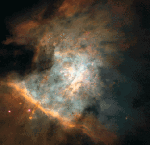 M42: Orion Nebula Mosaic
21.11.1995
The Great Nebula in Orion is one of the most interesting of all astronomical nebulae known. Here fifteen pictures from the Hubble Space Telescope have been merged to show the great expanse and diverse nature of the nebula.
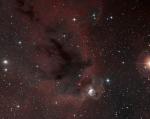 LDN 1622: Dark Nebula in Orion
11.05.2007
The silhouette of an intriguing dark nebula inhabits this cosmic scene, based on images from the Palomar Observatory Sky Survey. Lynds' Dark Nebula (LDN) 1622 appears against a faint background of glowing hydrogen gas only easily seen in long telescopic exposures of the region.
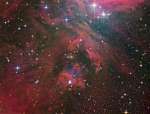 South of Orion
3.04.2008
This tantalizing array of nebulae and stars can be found about 2 degrees south of the famous star-forming Orion Nebula. The region abounds with energetic young stars producing jets and outflows that push through the surrounding material at speeds of hundreds of kilometers per second.
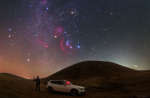 Orionid Meteors from Orion
30.10.2017
Meteors have been shooting out from the constellation of Orion. This was expected, as October is the time of year for the Orionids Meteor Shower. Pictured here, over a dozen meteors were caught in successively added exposures last weekend over Wulan Hada volcano in Inner Mongolia, China.
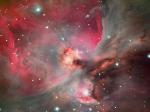 The Great Nebula in Orion
13.02.2002
Few astronomical sights excite the imagination like the nearby stellar nursery known as the Orion Nebula. The Nebula's glowing gas surrounds hot young stars at the edge of an immense interstellar molecular cloud only 1500 light-years away.
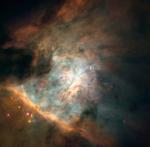 M42: A Mosaic of Orion's Great Nebula
22.05.1999
The Great Nebula in Orion, an immense, nearby starbirth region, is probably the most famous of all astronomical nebulae. Here, 15 pictures from the Hubble Space Telescope have been mosaicked to cover the inner 2.5 light years of the nebula and illustrate its diverse nature.
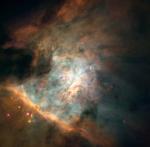 M42: A Mosaic of Orion's Great Nebula
11.05.1997
The Great Nebula in Orion, an immense, nearby starbirth region, is probably the most famous of all astronomical nebulae. Here, 15 pictures from the Hubble Space Telescope have been mosaicked to cover the inner 2.5 light years of the nebula and illustrate its diverse nature.
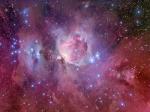 M42: Wisps of the Orion Nebula
20.11.2006
The Great Nebula in Orion, an immense, nearby starbirth region, is probably the most famous of all astronomical nebulas. Here, glowing gas surrounds hot young stars at the edge of an immense interstellar molecular cloud only 1500 light-years away. In the above deep image, faint wisps and sheets of dust and gas are particularly evident.
 IRAS Orion
31.07.1998
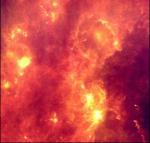
Do you recognize the constellation Orion? This striking but unfamiliar looking picture of the familiar Orion region of the sky was produced using survey data from the InfraRed Astronomical Satellite (IRAS). It combines information...
 Orion's Horsehead Nebula
2.10.1996
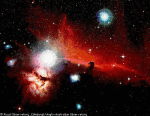
The Horsehead Nebula is arguably the most famous nebula on the sky. It is visible as the black indentation to the red emission nebula seen just to the right of center of the above photograph. The bright star near the center is located in the belt of the familiar constellation of Orion.
|
January February March April May June July August September |
|||||||||||||||||||||||||||||||||||||||||||||||||