
|
You entered: Mercury surface
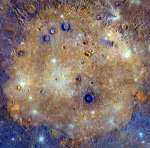 Enhanced Color Caloris
4.03.2015
The sprawling Caloris basin on Mercury is one of the solar system's largest impact basins, created during the early history of the solar system by the impact of a large asteroid-sized body.
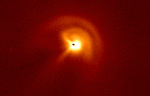 The Rotating Jets of Comet Hyakutake
14.04.1996
Comet Hyakutake will reach its closest point to the Sun on May 1, passing well inside the orbit of Mercury. At this time, the comet's dust and ion tail will be at their greatest physical length.
 APOD: 2025 September 1 Б Callisto: Dirty Battered Iceball
1.09.2025
Its surface is the most densely cratered in the Solar System -- but what's inside? Jupiter's moon Callisto is a battered ball of dirty ice that is larger than the planet Mercury.
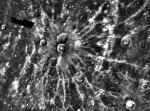 Degas Ray Crater on Mercury
8.12.1996
Like the Earth's Moon, Mercury is scarred with craters, testifying to an intense bombardment during the early history of the Solar System. In 1974, the Mariner 10 spacecraft surveyed this innermost planet up close, producing the only detailed images of its tortured surface.
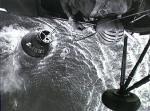 Liberty Bell 7
6.05.1999
Today, the space capsule Liberty Bell 7 rests about 3 miles below the surface of the Atlantic Ocean. But on July 21, 1961, astronaut Virgil I. "Gus" Grissom rode this tiny craft 118 miles above the Earth to become the second American in space.
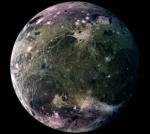 Ganymede Mosaic
4.03.1999
Ganymede, one of the four Galilean moons of Jupiter, is the largest moon in the Solar System. With a diameter of 5,260 kilometers it is even larger than planets Mercury and Pluto and just over three quarters the size of Mars. Ganymede is locked in synchronous rotation with Jupiter.
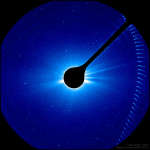 Comet Machholz Approaches the Sun
13.11.2017
Why is Comet Maccholz so depleted of carbon-containing chemicals? Comet 96P/Machholz's original fame derives from its getting closer to the Sun than any other short period comet -- half as close as Mercury -- and doing so every five years.
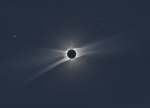 A Darkened Sky
20.09.2008
For a moment on August 1st, the daytime sky grew dark along the path of a total solar eclipse. While watching the geocentric celestial event from Mongolia, photographer Miloslav Druckmuller recorded multiple images with two separate cameras as the Moon blocked the bright solar disk and darkened the sky.
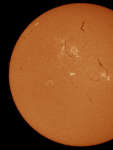 A Transit of Mercury
12.05.2016
On May 9, the diminutive disk of Mercury spent about seven and a half hours crossing in front of the Sun as viewed from the general vicinity of Earth. It was the second of 14 transits of the Solar System's innermost planet in the 21st century.
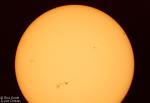 Spot The Planet
10.12.1999
OK, it's a picture of the Sun (duh!), but can you spot the planet? Of course, most of the spots you've spotted are sunspots, as large or larger than planet Earth itself.
|
January February March April May June July August |
||||||||||||||||||||||||||||||||||||||||||||||||||||||||