
|
You entered: Jupiter's Moons
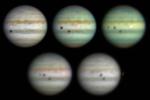 A Triple Eclipse on Jupiter
2.02.1998
Part of Jupiter is missing. Actually, three parts appear to be missing. In reality though, the three dark spots seen in the above photograph are only shadows. The unusual alignment of three of Jupiter's moons between the Jovian giant and the Sun was imaged last November 10th.
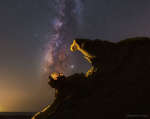 Jupiter Engulfed and the Milky Way
7.08.2019
This is a good month to see Jupiter. To find our Solar System's largest planet in your sky, look toward the southeast just after sunset -- Jupiter should be the brightest object in that part of the sky.
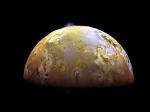 Io: The Prometheus Plume
11.02.2007
What's happening on Jupiter's moon Io? Two sulfurous eruptions are visible on Jupiter's volcanic moon Io in this color composite image from the robotic Galileo spacecraft that orbited Jupiter from 1995 to 2003.
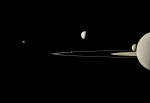 Moons of Saturn
17.10.2019
On July 29, 2011 the Cassini spacecraft's narrow-angle camera took this snapshot and captured 5 of Saturn's moons, from just above the ringplane. Left to right are small moons Janus and Pandora respectively 179 and 81 kilometers across, shiny 504 kilometer diameter Enceladus, and Mimas, 396 kilometers across, seen just next to Rhea.
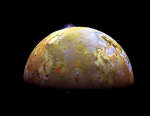 Io: The Prometheus Plume
22.05.2011
What's happening on Jupiter's moon Io? Two sulfurous eruptions are visible on Jupiter's volcanic moon Io in this color composite image from the robotic Galileo spacecraft that orbited Jupiter from 1995 to 2003.
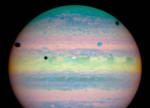 Pastel Planet, Triple Eclipse
11.11.2004
This false-color image of banded gas giant Jupiter shows a triple eclipse in progress on March 28 - a relatively rare event, even for a large planet with many moons. Captured by the Hubble Space...
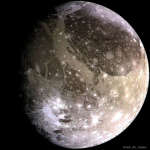 Ganymede: The Largest Moon
14.05.2017
What does the largest moon in the Solar System look like? Jupiter's moon Ganymede, larger than even Mercury and Pluto, has an icy surface speckled with bright young craters overlying a mixture of older, darker, more cratered terrain laced with grooves and ridges.
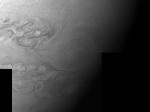 New Horizons Spacecraft Passes Jupiter
7.03.2007
A new spacecraft is headed for the outer Solar System. Named New Horizons, this robotic explorer passed Jupiter last week after being launched only in early 2006. New Horizons is being pulled by Jupiter's gravity to a greater speed toward its next target: Pluto in 2015.
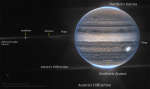 Jupiter from the Webb Space Telescope
30.08.2022
This new view of Jupiter is illuminating. High-resolution infrared images of Jupiter from the new James Webb Space Telescope (Webb) reveal, for example, previously unknown differences between high-floating bright clouds -- including the Great Red Spot -- and low-lying dark clouds.
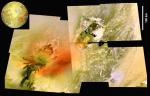 Io Volcano Culann Patera
18.12.2002
What causes the unusual colors surrounding Io's volcanoes? Io, the innermost large moon of Jupiter, is known to be the most tumultuous body in the Solar System. Approximately the size of Earth...
|
January February March April May June July August September |
|||||||||||||||||||||||||||||||||||||||||||||||||