
|
You entered: wind
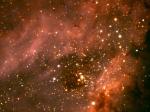 Composing the Omega Nebula
11.12.2000
The Omega Nebula is a massive, complex cloud of dust and gas from which new stars are continually forming. The similarity to the Greek letter capital Omega gives the molecular cloud its popular name, but the nebula is also known as the Swan Nebula, the Horseshoe Nebula, and M17.
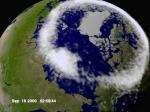 A Proton Aurora
17.12.2003
What are auroras made out of? Most auroras are caused by the solar wind exciting electrons that are funneled down the Earth's magnetic field. These electrons strike air molecules, liberating other electrons that glow when re-acquired.
 Massive Star Forming Region DR21 in Infrared
14.04.2004
Deep in the normally hidden recesses of giant molecular cloud DR21, a stellar nursery has been found creating some of the most massive stars yet recorded. The orbiting Spitzer Space Telescope's Infrared Array Camera opened the window into the cloud last year in mid- infrared light.
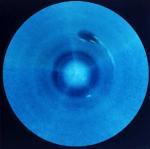 Southern Neptune
10.07.1999
Neptune, the Solar System's outermost gas giant planet, is 30 times farther from the Sun than Earth. Twelve years after a 1977 launch, Voyager 2 flew by Neptune and found surprising activity on a planet that receives only 3 percent as much sunlight as Jupiter.
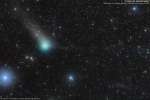 Comet PanSTARRS in the Southern Fish
17.06.2016
Now approaching our fair planet this Comet PanSTARRS (C/2013 X1) will come closest on June 21-22, a mere 5.3 light-minutes away. By then its appearance low in northern hemisphere predawn skies (high in the south), will be affected by the light of a nearly Full Moon, though.
 APOD: 2023 July 24 Б Chemicals Glow as a Meteor Disintegrates
24.07.2023
Meteors can be colorful. While the human eye usually cannot discern many colors, cameras often can. Pictured here is a fireball, a disintegrating meteor that was not only one of the brightest the photographer has ever seen, but colorful.
 APOD: 2024 October 15 Б Animation: Comet Tsuchinshan ATLAS Tails Prediction
15.10.2024
How bright and strange will the tails of Comet Tsuchinshan-ATLAS become? The comet has brightened dramatically over the few weeks as it passed its closest to the Sun and, just three days ago, passed its closest to the Earth.
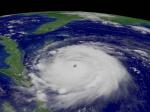 Hurricane Frances Approaches Florida
3.09.2004
A major hurricane is heading for Florida. Hurricane Frances, one of the stronger storm systems of modern times, may cross the eastern coast of Florida sometime tomorrow. Those in the path of a hurricane should take precautions. For example, NASA's Kennedy Space Center has completely shut down.
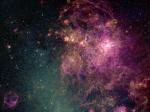 30 Doradus: The Tarantula Zone
12.12.2005
The Tarantula Nebula is more than 1,000 light-years across - a giant emission nebula within our neighboring galaxy the Large Magellanic Cloud. Inside this cosmic arachnid lies a central young cluster of massivestars, cataloged as R136, whose intense radiation and strong winds have helped energize the nebular glow and shape the spidery filaments.
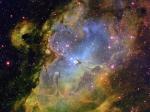 Inside the Eagle Nebula
26.02.2006
From afar, the whole thing looks like an Eagle. A closer look at the Eagle Nebula, however, shows the bright region is actually a window into the center of a larger dark shell of dust. Through this window, a brightly-lit workshop appears where a whole open cluster of stars is being formed.
|
January February March April May June |
|||||||||||||||||||||||||||||||||||||||||||||||||