
|
You entered: nebula
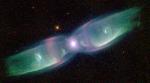 M2-9: Wings of a Planetary Nebula
23.12.1997
Are stars better appreciated for their art after they die? Actually, stars usually create their most artistic displays as they die. In the case of low-mass stars like our Sun and M2-9 pictured above, the stars transform themselves from normal stars to white dwarfs by casting off their outer gaseous envelopes.
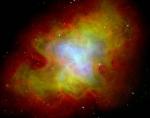 The Crab Nebula Pulsar Shrugs
20.09.2002
How does a city-sized neutron star power the vast Crab Nebula? The expulsion of wisps of hot gas at high speeds appears to be at least part of the answer. Yesterday time-lapse movies taken...
 APOD: 2024 September 24 Б NGC 6727: The Rampaging Baboon Nebula
24.09.2024
This dusty region is forming stars. Part of a sprawling molecular cloud complex that resembles, to some, a rampaging baboon, the region is a relatively close by 500 light-years away toward the constellation Corona Australis. That's about one third the distance of the more famous stellar nursery known as the Orion Nebula.
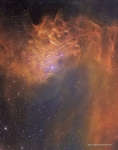 IC 405: The Flaming Star Nebula
7.01.2020
Rippling dust and gas lanes give the Flaming Star Nebula its name. The orange and purple colors of the nebula are present in different regions and are created by different processes. The bright star...
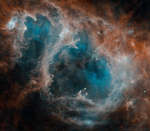 The Soul Nebula in Infrared from Herschel
4.10.2017
Stars are forming in the Soul of the Queen of Aethopia. More specifically, a large star forming region called the Soul Nebula can be found in the direction of the constellation Cassiopeia, who Greek mythology credits as the vain wife of a King who long ago ruled lands surrounding the upper Nile river.
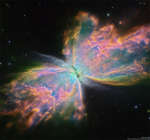 The Butterfly Nebula from Hubble
21.11.2022
Stars can make beautiful patterns as they age -- sometimes similar to flowers or insects. NGC 6302, the Butterfly Nebula, is a notable example. Though its gaseous wingspan covers over 3 light-years and its estimated...
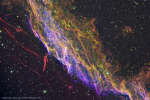 NGC 6992: Filaments of the Veil Nebula
1.12.2009
Wisps like this are all that remain visible of a Milky Way star. About 7,500 years ago that star exploded in a supernova leaving the Veil Nebula, also known as the Cygnus Loop.
 APOD: 2025 May 14 Б NGC 1360: The Robins Egg Nebula
14.05.2025
This pretty nebula lies some 1,500 light-years away, its shape and color in this telescopic view reminiscent of a robin's egg. The cosmic cloud spans about 3 light-years, nestled securely within the boundaries of the southern constellation of the Furnace (Fornax).
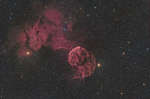 Sharpless 249 and the Jellyfish Nebula
23.03.2018
Normally faint and elusive, the Jellyfish Nebula is caught in this alluring telescopic image. Centered in the scene it's anchored right and left by two bright stars, Mu and Eta Geminorum, at the foot of the celestial twin. The Jellyfish Nebula is the brighter arcing ridge of emission with dangling tentacles.
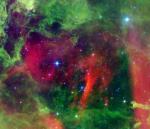 Hot Stars in the Rosette Nebula
26.07.2007
Winds and radiation from massive hot stars in the Rosette Nebula have cleared the natal gas and dust from the center of the nearby star-forming region. They also pose a danger to planet forming disks around young, cooler stars in the neighborhood.
|
January February March April May |
|||||||||||||||||||||||||||||||||||||||||||||||||