
|
You entered: Moon
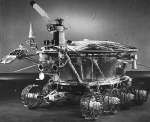 Lunokhod: Reflections on a Moon Robot
6.06.2010
It may look like some sort of cute alien robot, but it was created here on Earth, launched to the Moon in 1970, and now reflects laser light in a scientifically useful way. On November 17, 1970 the Soviet Luna 17 spacecraft landed the first roving remote-controlled robot on the Moon.
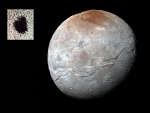 APOD: 2026 June 6 Б Charon: Moon of Pluto
6.06.2026
A darkened and mysterious north polar region known to some as Mordor Macula caps this premier view of Charon, Pluto's largest moon. The high-resolution image was captured by the interplanetary space probe New Horizons near its closest approach to distant Pluto on July 14, 2015.
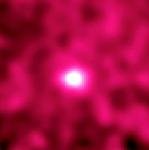 Gamma Ray Moon
17.04.1999
What if you could see gamma rays (photons with more than 40 million times the energy of visible light)? If you could, the Moon would appear brighter than the Sun! This startling notion...
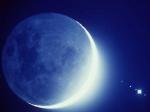 Tonight: A Blue Moon
31.07.2004
How often does a full moon occur twice in a single month? Exactly once in a Blue Moon. In fact, the modern usage of the term "Blue Moon" refers to the second Full Moon in a single month. Tonight's Blue Moon will be the first since November 2001.
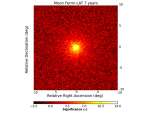 Fermi s Gamma-ray Moon
29.04.2016
If you could only see gamma-rays, photons with up to a billion or more times the energy of visible light, the Moon would be brighter than the Sun! That startling notion underlies this novel...
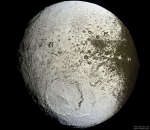 Saturns Iapetus: Painted Moon in 3D
13.07.2021
What has happened to Saturn's moon Iapetus? Vast sections of this strange world are dark brown, while others are as bright white. The composition of the dark material is unknown, but infrared spectra indicate that it possibly contains some dark form of carbon.
 Flying Over Plutos Moon Charon
22.02.2016
Given some poetic license, there is now scientific evidence that hell has frozen over. To start, Greek mythology holds that Charon is the ferryman of the underworld. Next, recent analysis of data taken...
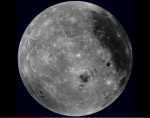 Rotating Moon from LRO
16.09.2013
No one, presently, sees the Moon rotate like this. That's because the Earth's moon is tidally locked to the Earth, showing us only one side. Given modern digital technology, however, combined with many detailed images returned by the Lunar Reconnaissance Orbiter (LRO), a high resolution virtual Moon rotation movie has now been composed.
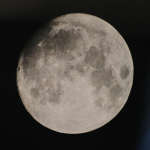 21st Century Wet Collodion Moon
2.01.2021
In the mid 19th century, one of the first photographic technologies used to record the lunar surface was the wet-plate collodion process, notably employed by British astronomer Warren De la Rue. To capture...
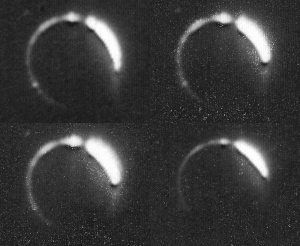 A Solar Eclipse from the Moon
7.04.2014
Has a solar eclipse ever been seen from the Moon? Yes, first in 1967 -- but it may happen again next week. The robotic Surveyor 3 mission took thousands of wide angle television images of the Earth in 1967, a few of which captured the Earth moving in front of the Sun.
|
January February March April May June July August September October |
|||||||||||||||||||||||||||||||||||||||||||||||||