
|
You entered: young stars
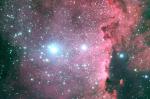 Hot Stars in the Southern Milky Way
7.05.1999
Hot blue stars, red glowing hydrogen gas, and dark, obscuring dust clouds are strewn through this dramatic region of the Milky Way in the southern constellation of Ara (the Altar). About 4,000 light-years from Earth, the stars at the left are young, massive, and energetic.
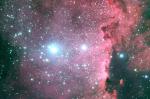 Hot Stars in the Southern Milky Way
22.12.2001
Hot blue stars, red glowing hydrogen gas, and dark, obscuring dust clouds are strewn through this dramatic region of the Milky Way in the southern constellation of Ara (the Altar). About 4,000 light-years from Earth, the stars at the left are young, massive, and energetic.
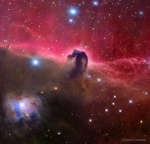 The Magnificent Horsehead Nebula
13.05.2015
Sculpted by stellar winds and radiation, a magnificent interstellar dust cloud by chance has assumed this recognizable shape. Fittingly named the Horsehead Nebula, it is some 1,500 light-years distant, embedded in the vast Orion cloud complex.
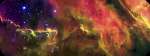 The Southern Cliff in the Lagoon
11.05.2011
Undulating bright ridges and dusty clouds cross this close-up of the nearby star forming region M8, also known as the Lagoon Nebula. A sharp, false-color composite of narrow band visible and broad band near-infrared...
 The W4 Chimney
7.02.2000
A huge chimney venting hot clouds of gas out from the plane of our Milky Way Galaxy has recently been imaged in radio waves. The Canadian Galactic Plane Survey team used an array of radio telescopes to survey an ionized gas region known as W4.
 The Lagoon Nebula is Stars, Gas, and Dust
12.11.2018
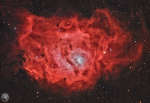
The majestic Lagoon Nebula is filled with hot gas and the home for many young stars. Spanning 100 light years across while lying only about 5000 light years distant, the Lagoon Nebula is so big and bright that it can be seen without a telescope toward the constellation of the Archer (Sagittarius).
 The Tarantula and the Supernova
27.10.1995
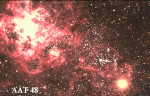
In this close-up of the Large Magellanic Cloud, the spidery looking nebula on the left is fittingly known as as the Tarantula nebula. It is an emission nebula surrounding a cluster of hot, young stars called the 30 Doradus super cluster.
 Carina Pillar and Jets
1.10.2009
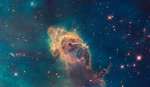
This cosmic pillar of gas and dust is nearly 2 light-years wide. The structure lies within one of our galaxy's largest star forming regions, the Carina Nebula, shining in southern skies at a distance of about 7,500 light-years.
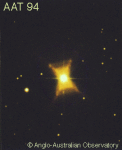 The Red Rectangle
2.11.1995
The unusual geometry of this stellar nebula creates somewhat of a mystery. At the nebula's center is a young binary star system that probably created the nebula, but how? This type of nebula shows a "bipolar flow" which carries a significant amount of mass away from the central stars.
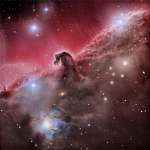 The Magnificent Horsehead Nebula
13.05.2010
Sculpted by stellar winds and radiation, a magnificent interstellar dust cloud by chance has assumed this recognizable shape. Fittingly named the Horsehead Nebula, it is some 1,500 light-years distant, embedded in the vast Orion cloud complex.
|
January February March April May June July August September |
|||||||||||||||||||||||||||||||||||||||||||||||||