
|
You entered: star system
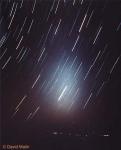 Zodiacal Light
13.06.1999
Sometimes the sky itself seems to glow. Usually, this means you are seeing a cloud reflecting sunlight or moonlight. If the glow appears as a faint band of light running across the whole sky, you are probably seeing the combined light from the billions of stars that compose our Milky Way Galaxy.
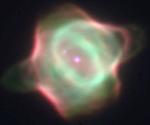 Hen 1357: New Born Nebula
3.04.1998
This Hubble Space Telescope picture shows Hen-1357, the youngest known planetary nebula. Graceful, gentle curves and symmetry suggest its popular name - The Stingray Nebula. Observations in the 1970s detected no nebular material, but this image from March 1996 clearly shows the Stingray's emerging bubbles and rings of shocked and ionized gas.
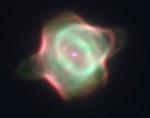 Hen 1357: New Born Nebula
6.10.2001
This Hubble Space Telescope snapshot shows Hen-1357, the youngest known planetary nebula. Graceful, gentle curves and symmetry suggest its popular name - The Stingray Nebula. Observations in the 1970s detected no nebular material, but this image from March 1996 clearly shows the Stingray's emerging bubbles and rings of shocked and ionized gas.
 Encke and the Tadpoles
27.10.2023
History's second known periodic comet is Comet Encke (2P/Encke). As it swings through the inner Solar System, Encke's orbit takes it from an aphelion, its greatest distance from the Sun, inside the orbit of Jupiter to a perihelion just inside the orbit of Mercury.
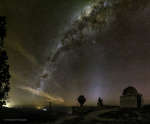 Milky Way over Bosque Alegre Station in Argentina
22.09.2015
What are those streaks of light in the sky? First and foremost, the arching structure is the central band of our Milky Way galaxy. Visible in this galactic band are millions of distant stars mixed with numerous lanes of dark dust.
 Comet Kudo-Fujikawa: Days in the Sun
30.01.2003
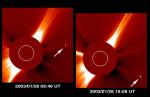
Cruising through the inner Solar System, new Comet Kudo-Fujikawa reached perihelion, its closest approach to the Sun, yesterday, January 29. Passing within 28.4 million kilometers of the Sun, this comet came much closer than innermost planet Mercury basking only 57.9 million kilometers from our parent star.
 Betelgeuse
19.04.1998
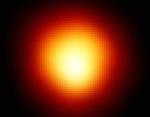
Here is the first direct picture of the surface of a star other than our Sun. Taken by the Hubble Space Telescope in 1995, the atmosphere of Betelgeuse reveals some unexpected features, including a large bright hotspot visible below the center.
 Hartley 2 Star Cluster Tour
2.12.2010
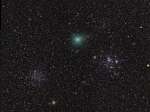
Early in November, small but active Comet Hartley 2 (103/P Hartley) became the fifth comet imaged close-up by a spacecraft from planet Earth. Continuing its own tour of the solar system with a 6 year orbital period, Hartley 2 is now appearing in the nautical constellation Puppis.
 2003 UB 313: A Tenth Planet?
1.08.2005
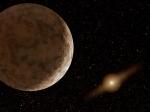
Has a tenth planet been discovered? A newly discovered object, designated 2003 UB 313 and located more than twice the distance of Pluto, is expected to be at least as large as Pluto and probably larger, given current measurements.
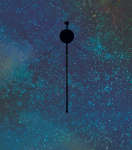 Interstellar Voyager
9.09.2022
Voyager 1 and Voyager 2 were launched in 1977 on a grand tour of the outer planets of the Solar System. They have become the longest operating and most distant spacecraft from Earth. Both have traveled beyond the heliosphere, the realm defined by the influence of the solar wind and the Sun's magnetic field.
|
January February March April May June |
|||||||||||||||||||||||||||||||||||||||||||||||||