
|
You entered: star cluster
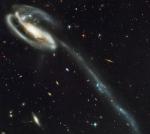 Arp 188 and the Tadpole s Tidal Tail
2.05.2002
In this stunning vista recorded with the Hubble Space Telescope's new advanced camera, distant galaxies form a dramatic backdrop for disrupted spiral galaxy Arp 188, the Tadpole Galaxy. The cosmic Tadpole is a mere 420 million light-years distant toward the northern constellation Draco.
 Arp 188 and the Tadpoles Tidal Tail
8.01.2006
In this stunning vista recorded with the Hubble Space Telescope's Advanced Camera for Surveys, distant galaxies form a dramatic backdrop for disrupted spiral galaxy Arp 188, the Tadpole Galaxy. The cosmic tadpole is a mere 420 million light-years distant toward the northern constellation Draco.
 Arp 188 and the Tadpole s Tidal Tail
15.05.2004
In this stunning vista recorded with the Hubble Space Telescope's Advanced Camera for Surveys, distant galaxies form a dramatic backdrop for disrupted spiral galaxy Arp 188, the Tadpole Galaxy. The cosmic tadpole is a mere 420 million light-years distant toward the northern constellation Draco.
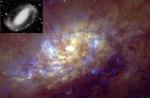 Starbirth in NGC 1808
23.03.1998
The center of galaxy NGC 1808 is bursting with new stars, but why? Being a barred spiral galaxy makes NGC 1808 somewhat similar to our own Milky Way Galaxy. But the disk of NGC 1808 (inset) is quite warped, and its center is unusually bright and blue.
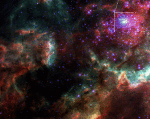 In the Center of 30 Doradus
4.10.1997
In the center of 30 Doradus lies a huge cluster of the largest, hottest, most massive stars known. The center of this cluster, known as R136, is boxed in the upper right portion of the above picture.
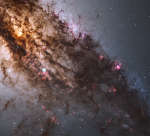 Central Centaurus A
22.02.2020
A mere 11 million light-years away, Centaurus A is the closest active galaxy to planet Earth. Also known as NGC 5128, the peculiar elliptical galaxy is over 60,000 light-years across. A region spanning about 8,500 light-years, including the galaxy's center (upper left), is framed in this sharp Hubble Space telescope close-up.
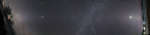 All Planets Panorama
25.02.2017
For 360 degrees, a view along the plane of the ecliptic is captured in this remarkable panorama, with seven planets in a starry sky. The mosaic was constructed using images taken during January 24-26, from Nacpan Beach, El Nido in Palawan, Philippines.
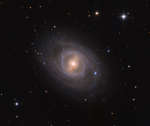 M95 with Supernova
22.03.2012
Barred spiral galaxy M95 is about 75,000 light-years across, comparable in size to our own Milky Way and one of the larger galaxies of the Leo I galaxy group. In fact, it is part of a not quite so famous trio of Leo galaxies with neighbors M96 and M105, about 38 million light-years distant.
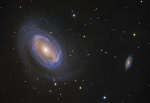 One Armed Spiral Galaxy NGC 4725
30.05.2013
While most spiral galaxies, including our own Milky Way, have two or more spiral arms, NGC 4725 has only one. In this sharp color composite image, the solo spira mirabilis seems to wind from a prominent ring of bluish, newborn star clusters and red tinted star forming regions.
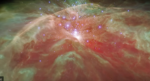 Flight Through the Orion Nebula in Infrared Light
7.07.2021
What would it look like to fly into the Orion Nebula? The exciting dynamic visualization of the Orion Nebula is based on real astronomical data and adept movie rendering techniques. Up close and personal...
|
January February March April May |
|||||||||||||||||||||||||||||||||||||||||||||||||