
|
You entered: young stars
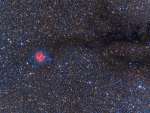 Cocoon Nebula Wide Field
29.09.2011
In this crowded starfield spanning some 3 degrees within the high flying constellation Cygnus, the eye is drawn to the Cocoon Nebula. A compact star forming region, the cosmic Cocoon punctuates a long trail of obscuring interstellar dust clouds.
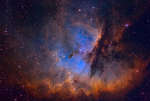 Portrait of NGC 281
4.11.2016
Look through the cosmic cloud cataloged as NGC 281 and you might miss the stars of open cluster IC 1590. Still, formed within the nebula that cluster's young, massive stars ultimately power the pervasive nebular glow.
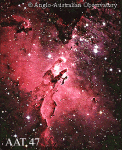 M16: Nebula With Star Cluster
18.01.1997
The photogenic M16 shown above is composed of a young star cluster associated with a spectacular emission nebulae lined with clouds of interstellar dust. The gorgeous spectacle lies toward the galactic center region, some 7,000 light years distant in the constellation Serpens.
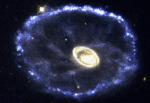 The Cartwheel Galaxy
2.07.1995
The Cartwheel Galaxy shows a ring that is the result of a collision between a small and a large galaxy. After a small galaxy has moved through a big galaxy - in this case...
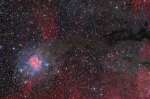 Cocoon Nebula Wide Field
13.09.2012
In this crowded starfield covering over 2 degrees within the high flying constellation Cygnus, the eye is drawn to the Cocoon Nebula. A compact star forming region, the cosmic Cocoon punctuates a long trail of obscuring interstellar dust clouds.
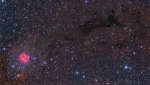 Cocoon Nebula Wide Field
18.09.2014
In this crowded starfield covering over 2 degrees within the high flying constellation Cygnus, the eye is drawn to the Cocoon Nebula. A compact star forming region, the cosmic Cocoon punctuates a long trail of obscuring interstellar dust clouds.
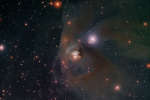 T Tauri: A Star is Formed
3.08.2009
What does a star look like when it is forming? The prototypical example is the variable star T Tauri, visible as the bright orange star near the image center. The orange star centered in this remarkable telescopic skyview is T Tauri, prototype of the class of T Tauri variable stars.
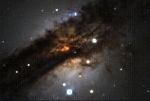 Dusty Galaxy Centaurus A
28.08.1995
One of the most unusual galaxies known, Centaurus A, is pictured above. Cen A is marked by dramatic dust lanes that run across the galaxy's center. These dust lanes are so thick they almost completely obscure the galaxy's center in visible light.
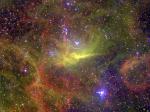 Nebulas Surrounding Wolf Rayet Binary
BAT99 49
Nebulas Surrounding Wolf Rayet Binary
BAT99 49
21.04.2004
How could two young stars power these colorful interstellar gas clouds? Although hidden by thick dust, the stars spew forceful ions and energetic radiation that cause the clouds to fragment and light up.
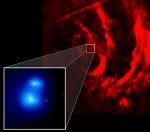 Around The Arches Cluster
14.06.2001
The most compact cluster of stars known in our galaxy, the Arches cluster, boasts 100 or so massive, young stars contained within a diameter of one light-year. Seen toward the constellation Sagittarius, the Arches...
|
January February March April May June July August September |
|||||||||||||||||||||||||||||||||||||||||||||||||