
|
You entered: shadow
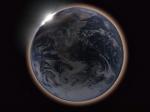 Solar Eclipse from the Moon
2.03.2007
Parts of Saturday's (March 3) lunar eclipse will be widely visible. For example, skywatchers in Europe, Africa, and western Asia will be able to see the entire spectacle of the Moon gliding through Earth's shadow, but in eastern North America the Moon will rise already in its total eclipse phase.
 August Moons
21.08.2008
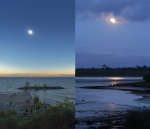
This August was eclipse season. The month's first New Moon and Full Moon were both seen in darkened skies during a solar and lunar eclipse. Blocking the Sun, the left panel...
 An Apollo 15 Panorama: Astronaut Exploring
30.11.2008
What would it be like to explore the Moon? NASA's Apollo missions gave humans just this chance in the late 1960s and early 1970s. In particular, the Apollo 15 mission was dedicated to better understanding the surface of the Moon by exploring mountains, valleys, maria, and highlands.
 Crescent Rhea Occults Crescent Saturn
20.07.2008
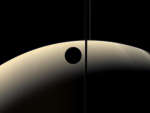
Soft hues, partially lit orbs, a thin trace of the ring, and slight shadows highlight this understated view of the majestic surroundings of the giant planet Saturn. Looking nearly back toward the Sun, the robot Cassini spacecraft now orbiting Saturn captured crescent phases of Saturn and its moon Rhea in color a few years ago.
 Looking Back at an Eclipsed Earth
30.05.2012
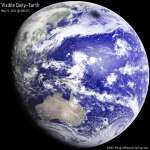
What's that dark spot on planet Earth? It's the shadow of the Moon. The above image of Earth was taken last week by MTSAT during an annular eclipse of the Sun. The dark spot appears quite unusual as clouds are white and the oceans are blue in this color corrected image.
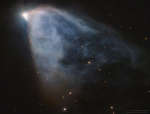 NGC 2261: Hubble s Variable Nebula
8.11.2017
What causes Hubble's Variable Nebula to vary? The unusual nebula featured here changes its appearance noticeably in just a few weeks. Discovered over 200 years ago and subsequently cataloged as NGC 2661, the remarkable nebula is named for Edwin Hubble, who studied it early last century.
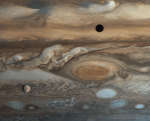 Europa and Jupiter from Voyager 1
28.06.2020
What are those spots on Jupiter? Largest and furthest, just right of center, is the Great Red Spot -- a huge storm system that has been raging on Jupiter possibly since Giovanni Cassini's likely notation of it 355 years ago. It is not yet known why this Great Spot is red.
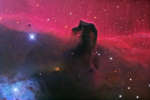 The Horsehead Nebula in Orion
26.11.2008
One of the most identifiable nebulae in the sky, the Horsehead Nebula in Orion, is part of a large, dark, molecular cloud. Also known as Barnard 33, the unusual shape was first discovered on a photographic plate in the late 1800s.
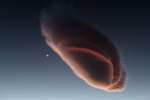 Lenticular Cloud, Moon, Mars, Venus
1.03.2015
It is not every day that such an interesting cloud photobombs your image. The original plan was to photograph a rare angular conjunction of Mars and Venus that occurred a week and a half ago, with the added bonus of a crescent Moon and the International Space Station (ISS) both passing nearby.
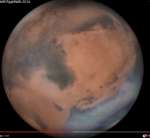 Mars at Closest Approach 2016
9.08.2016
When does Mars appear the largest? This occurs when Earth sweeps past Mars in their respective orbits around the Sun, creating a momentary Sun-Earth-Mars alignment called opposition. The featured video shows the Mars opposition that occurred earlier this year. All of the images were taken from Earth with a small telescope.
|
January February March April May |
|||||||||||||||||||||||||||||||||||||||||||||||||