
|
You entered: night sky
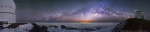 Mauna Kea Milky Way Panorama
19.02.2009
Aloha and welcome to a breathtaking skyscape. The dreamlike panoramic view looks out from the 4,200 meter volcanic summit of Mauna Kea, Hawai'i, across a layer of clouds toward a starry night sky and the rising Milky Way.
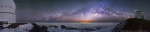 Milky Way Panorama from Mauna Kea
10.03.2013
Aloha and welcome to a breathtaking skyscape. The dreamlike panoramic view looks out from the 4,200 meter volcanic summit of Mauna Kea, Hawai'i, across a layer of clouds toward a starry night sky and the rising Milky Way.
 Venus, Jupiter, and Noctilucent Clouds
1.07.2015
Have you seen the passing planets yet? Today the planets Jupiter and Venus pass within half a degree of each other as seen from Earth. This conjunction, visible all over the world, is quite easy to see -- just look to the west shortly after sunset.
 APOD: 2024 December 22 Б The Local Fluff
22.12.2024
The stars are not alone. In the disk of our Milky Way Galaxy, about 10 percent of visible matter is in the form of gas called the interstellar medium (ISM). The ISM is not uniform and shows patchiness even near our Sun.
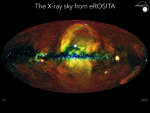 The X Ray Sky from eROSITA
23.06.2020
What if you could see X-rays? The night sky would seem a strange and unfamiliar place. X-rays are about 1,000 times more energetic than visible light photons and are produced by violent explosions and high temperature astronomical environments.
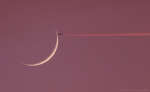 Fly Me to the Moon
17.01.2017
No, this is not a good way to get to the Moon. What is pictured is a chance superposition of an airplane and the Moon. The contrail would normally appear white, but the large volume of air toward the setting Sun preferentially knocks away blue light, giving the reflected trail a bright red hue.
 Clusters, Hartley, and the Heart
14.10.2010
An alluring Comet Hartley 2 cruised through planet Earth's night sky on October 8, passing within about a Full Moon's width of the famous double star cluster in Perseus. The much anticipated...
 4000 Exoplanets
10.07.2019
Over 4000 planets are now known to exist outside our Solar System. Known as exoplanets, this milestone was passed last month, as recorded by NASA's Exoplanet Archive. The featured video highlights these exoplanets in sound and light, starting chronologically from the first confirmed detection in 1992.
 Cygnus X: The Inner Workings of a Nearby Star Factory
18.01.2012
How do stars form? To help study this complex issue, astronomers took a deep infrared image of Cygnus X, the largest known star forming region in the entire Milky Way Galaxy. The above recently-released...
 Ice Ring around Nearby Star Fomalhaut
3.10.2017
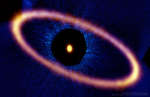
Why is there a large ice ring around Fomalhaut? This interesting star -- easily visible in the night sky -- lies only about 25 light-years away and is known to be orbited by at least one planet, Dagon, as well as several inner dust disks.
|
January February March April May |
|||||||||||||||||||||||||||||||||||||||||||||||||