
|
You entered: massive stars
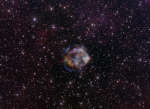 Cas A: Optical and X ray
17.01.2013
The aftermath of a cosmic cataclysm, supernova remnant Cassiopeia A (Cas A) is a comfortable 11,000 light-years away. Light from the Cas A supernova, the death explosion of a massive star, first reached Earth just 330 years ago.
 NGC 6888: The Crescent Nebula
27.11.2025
NGC 6888, also known as the Crescent Nebula, is a about 25 light-years across, a cosmic bubble blown by winds from its central, massive star. This deep telescopic image includes narrowband image data, to isolate light from hydrogen and oxygen atoms.
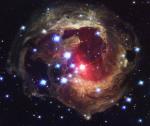 V838 Mon: Light Echo Update
3.02.2005
Expanding light echoes continue to illuminate the dusty environs of V838 Monocerotis, mysterious variable star near the edge of our Galaxy. This stunning image, produced from Hubble data recorded in October of 2004, adds to a unique series of space-based, high-resolution views.
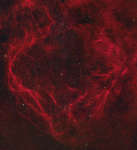 RCW 114: A Dragon s Heart in Ara
10.01.2018
Large and dramatically shaped, this cosmic cloud spans nearly 7 degrees or 14 full moons across planet Earth's sky toward the southern constellation Ara. Difficult to image, the filamentary apparition is cataloged as RCW 114 and traced in this telescopic mosaic by the telltale reddish emission of ionized hydrogen atoms.
 Rigel Wide
6.04.2023
Brilliant, blue, supergiant star Rigel marks the foot of Orion the Hunter in planet Earth's night. Designated Beta Orionis, it's at the center of this remarkably deep and wide field of view.
 APOD: 2023 December 26 Б IC 443: The Jellyfish Nebula
25.12.2023
Why is this jellyfish swimming in a sea of stars? Drifting near bright star Eta Geminorum, seen at the right, the Jellyfish Nebula extends its tentacles from the bright arcing ridge of emission left of center.
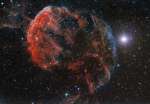 The Elusive Jellyfish Nebula
9.01.2013
Normally faint and elusive, the Jellyfish Nebula is caught in this alluring telescopic view. Drifting near bright star Eta Geminorum, at the foot of a celestial twin, the Jellyfish Nebula is seen dangling tentacles from the bright arcing ridge of emission left of center.
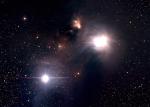 Dust and Gas Surrounding Star R Coronae Australis
16.10.2000
Young star R Coronae Australis has a dusty home. The dust is so thick on the upper left of the above photograph that little light from background stars comes through. Thinner dust near the stars reflects light from R Coronae Australis (upper right) and neighbor TY Coronae Australis, giving their surroundings a flowing appearance.
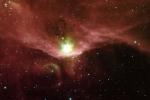 Sharpless 140
20.05.2004
Three young, massive stars will eventually emerge from this natal cloud of dust and gas, but their presence is already revealed in this false-color image from the Spitzer Space Telescope. The picture offers...
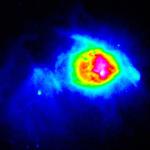 Hydrogen Blob N88A in the Small Magellanic Cloud
29.07.1999
The bright blob of hydrogen gas cataloged as N88A is seen at the right. It measures a mere 3 light years across. Emerging from the cool, dusty interstellar medium in a nearby irregular galaxy known as the Small Magellanic Cloud, N88A hides hot young stars at its core.
|
January February |
|||||||||||||||||||||||||||||||||||||||||||||||||