
|
You entered: clouds
 A Dark Seahorse in Cepheus
7.11.2025
Spanning light-years, this suggestive shape known as the Seahorse Nebula floats in silhouette against a rich background of stars and glowing hydrogen gas. Seen toward the royal northern constellation of Cepheus, the dusty, dark nebula is part of a Milky Way molecular cloud some 1,200 light-years distant.
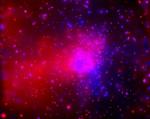 X Rays from M17
21.08.2003
About 5,000 light-years away, toward the constellation Sagittarius and the center of our galaxy, lies the bright star forming region cataloged as M17. In visible light, M17's bowed and hollowed-out appearance has resulted in many popular names like the Horseshoe, Swan, Omega, and Lobster nebula. But what has sculpted this glowing gas cloud?
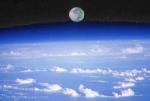 Moonrise, Planet Earth
27.05.1997
During the Astro-1 astronomy mission of December, 1990, Space Shuttle astronauts photographed this stunning view of the full moon rising above the Earth's limb. In the foreground, towering clouds of condensing water vapor mark the extent of the troposphere, the lowest layer of the planet's life-sustaining atmosphere.
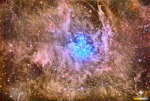 The Pleiades Deep and Dusty
14.11.2017
The well-known Pleiades star cluster is slowly destroying part of a passing cloud of gas and dust. The Pleiades is the brightest open cluster of stars on Earth's sky and can be seen from almost any northerly location with the unaided eye.
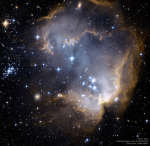 APOD: 2026 April 13 Б NGC 602 and Beyond
13.04.2026
The clouds may look like an oyster, and the stars like pearls, but look beyond. Near the outskirts of the Small Magellanic Cloud, a satellite galaxy some 200 thousand light-years distant, lies 5 million year young star cluster NGC 602.
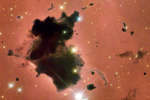 Thackerays Globules
28.12.2008
Rich star fields and glowing hydrogen gas silhouette dense, opaque clouds of interstellar gas and dust in this Hubble Space Telescope close-up of IC 2944, a bright star forming region in Centaurus, 5,900 light-years away. The largest of these dark globules, first spotted by South African astronomer A. D.
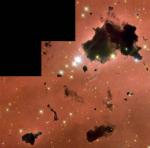 Thackeray's Globules
8.01.2002
Rich star fields and glowing hydrogen gas silhouette dense, opaque clouds of interstellar gas and dust in this Hubble Space Telescope close-up of IC 2944, a bright star forming region in Centaurus, 5,900 light-years away. The largest of these dark globules, first spotted by South African astronomer A. D.
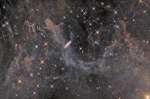 Galaxies, Stars, and Dust
13.10.2012
Spiky stars and spooky shapes abound in this deep cosmic skyscape. Its well-composed field of view covers about 2 Full Moons on the sky toward the constellation Pegasus. Of course the brighter stars show diffraction spikes, the commonly seen effect of internal supports in reflecting telescopes, and lie well within our own Milky Way galaxy.
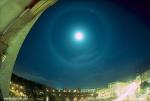 A Halo Around the Moon
15.05.2000
Have you ever seen a halo around the Moon? This fairly common sight occurs when high thin clouds containing millions of tiny ice crystals cover much of the sky. Each ice crystal acts like a miniature lens.
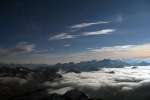 Pyrenees Paraselene
11.06.2009
A sea of clouds laps at rugged moutain peaks of the French Pyrenees in this serene view from Pic du Midi Observatory. The time exposure was recorded on June 4, with the constellations Sagittarius and Scorpius shining in the starry night. At the top right lies a faint, but colorful moondog or paraselene.
|
January February March April May June July August September |
|||||||||||||||||||||||||||||||||||||||||||||||||