
|
You entered: water
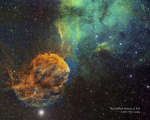 Sharpless 249 and the Jellyfish Nebula
7.01.2017
Normally faint and elusive, the Jellyfish Nebula is caught in this alluring telescopic mosaic. The scene is anchored below by bright star Eta Geminorum, at the foot of the celestial twin, while the Jellyfish Nebula is the brighter arcing ridge of emission with tentacles dangling below and left of center.
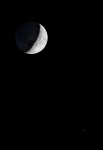 Jupiter and the Moons
5.10.2019
After sunset on October 3, some of the Solar System's largest moons stood low along the western horizon with the largest planet. Just after nightfall, a pairing of the Moon approaching first quarter phase and Jupiter was captured in this telephoto field of view.
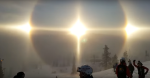 Sun Halo over Sweden
28.12.2021
What's happened to the Sun? Sometimes it looks like the Sun is being viewed through a giant lens. In the featured video, however, there are actually millions of tiny lenses: ice crystals. Water may freeze in the atmosphere into small, flat, six-sided, ice crystals.
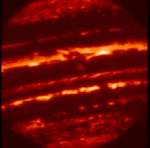 Beneath Jupiter's Clouds
23.01.1996
This near-infrared image of Jupiter was made using instrumentation at NASA's Infrared Telescope Facility, located on the summit of Mauna Kea, Hawaii, in support of the Galileo mission to Jupiter. The brightest spots...
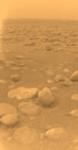 Titan Landscape
17.01.2005
This color view from Titan gazes across a suddenly familiar but distant landscape on Saturn's largest moon. The scene was recorded by ESA's Huygens probe after a 2 1/2 hour descent through a thick atmosphere of nitrogen laced with methane.
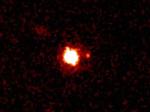 Eris: The Largest Known Dwarf Planet
18.09.2006
Is Pluto the largest dwarf planet? No! Currently, the largest known dwarf planet is (136199) Eris, renamed last week from 2003 UB313. Eris is just slightly larger than Pluto, but orbits as far as twice Pluto's distance from the Sun.
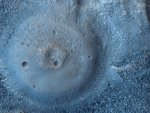 Possible Mud Volcanoes on Mars
30.03.2009
Is this a mud volcano on Mars? If so, could it be dredging up martian microbes? This strange possibility has been suggested recently and seems to fit several recent observations of Mars. First of all, hills like this seem to better resemble mud volcanoes on Earth than lava volcanoes and impact craters on Mars.
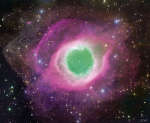 The Helix Nebula from CFHT
3.01.2018
Will our Sun look like this one day? The Helix Nebula is one of brightest and closest examples of a planetary nebula, a gas cloud created at the end of the life of a Sun-like star.
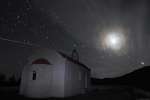 Atlantis over Rhodes
28.05.2010
A moonlit chapel stands in the foreground of this night-scape from the historic Greek island of Rhodes. The tantalizing sky above features a colorful lunar corona, where bright moonlight is diffracted by water droplets in the thin clouds drifting in front of the lunar disk.
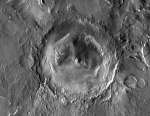 Gale Crater
29.07.2011
This sharp view from the Thermal Emission Imaging System camera on NASA's Mars Odyssey orbiter is centered on 154 kilometer (96 mile) wide Gale crater, near the martian equator. Within Gale, an impressive layered mountain rises about 5 kilometers (3 miles) above the crater floor.
|
January February |
|||||||||||||||||||||||||||||||||||||||||||||||||