
|
You entered: dark
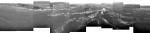 Eight Kilometers Above Titan
19.01.2005
What are these surface features on Titan? Scroll right to see the panoramic view captured last week by the Huygens probe as it descended toward Saturn's mysterious moon. Scientists are not yet sure what the above image is showing.
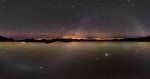 A Tale of Two Hemispheres
30.07.2011
A quest to find planet Earth's darkest night skies led to this intriguing panorama. In projection, the mosaic view sandwiches the horizons visible in all-sky images taken from the northern hemisphere's Canary Island of La Palma (top) and the south's high Atacama Desert between the two hemispheres of the Milky Way Galaxy.
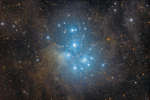 M45: The Pleiades Star Cluster
18.09.2013
Have you ever seen the Pleiades star cluster? Even if you have, you probably have never seen it as dusty as this. Perhaps the most famous star cluster on the sky, the bright stars of the Pleiades can be seen without binoculars from even the depths of a light-polluted city.
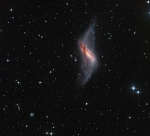 Polar Ring Galaxy NGC 660
17.02.2017
NGC 660 is featured in this cosmic snapshot. Over 40 million light-years away and swimming within the boundaries of the constellation Pisces, NGC 660's peculiar appearance marks it as a polar ring galaxy.
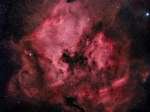 North America and the Pelican
1.12.2017
Fans of our fair planet might recognize the outlines of these cosmic clouds. On the left, bright emission outlined by dark, obscuring dust lanes seems to trace a continental shape, lending the popular name North America Nebula to the emission region cataloged as NGC 7000.
 Orion and the Ocean of Storms
7.12.2023
On December 5, 2022, a camera on board the uncrewed Orion spacecraft captured this view as Orion approached its return powered flyby of the Moon. Beyond one of Orion's extended solar arrays lies dark, smooth, terrain along the western edge of the Oceanus Procellarum.
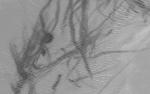 Martian Dust Devil Trails
17.03.2000
Who's been marking up Mars? This portion of a recent high-resolution picture from the orbiting Mars Global Surveyor spacecraft shows twisting dark trails criss-crossing a relatively flat rippled region about 3 kilometers wide on the martian surface.
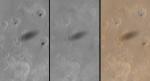 Shadow Of Phobos
5.11.1999
Hurtling through space above the Red Planet, potato-shaped Phobos completes an orbit of Mars in less than eight hours. In fact, since its orbital period is shorter than the planet's rotation period, Mars-based...
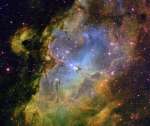 The Eagle Nebula from Kitt Peak
16.04.2012
From afar, the whole thing looks like an Eagle. A closer look at the Eagle Nebula, however, shows the bright region is actually a window into the center of a larger dark shell of dust. Through this window, a brightly-lit workshop appears where a whole open cluster of stars is being formed.
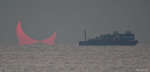 A Distorted Sunrise Eclipse
28.12.2019
Yes, but have you ever seen a sunrise like this? Here, after initial cloudiness, the Sun appeared to rise in two pieces and during partial eclipse, causing the photographer to describe it as the most stunning sunrise of his life.
|
January February March April May June July August September |
|||||||||||||||||||||||||||||||||||||||||||||||||