
|
You entered: star system
 APOD: 2026 June 1 Б Saturn at Night
31.05.2026
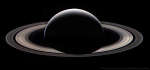
Telescopic views of Saturn and its beautiful rings often make it the star of star parties. But this stunning view of the outer gas gaint planet's rings and night side just isn't possible from telescopes in the vicinity of planet Earth.
 Chilean Skyscape
28.11.2008
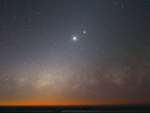
Night skies over Chilean mountain top observatories can be dark and clear, with glorious cosmic vistas. In this recent example, the plane of our Milky Way galaxy stretches parallel to the horizon, the galactic center's star clusters, dark dust clouds, and glowing nebulae hovering in the west.
 Dad Quiets Omicron Ceti
1.04.2012
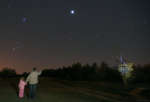
The Omicron Cetians have been silenced. After alien-like monsters were reported to disturb his daughter's sleep for four nights in a row, this father took action. When last questioned, the daughter seemed to indicate that the hullabaloo might have come from a planetary system possibly sounding like "Omicron Ceti".
 Comet ATLAS Breaks Up
15.04.2020
Cruising through the inner solar system, Comet ATLAS C2019/Y4 has apparently fragmented. Multiple separate condensations within its diffuse coma are visible in this telescopic close-up from April 12, composed of frames tracking the comet's motion against trailing background stars.
 Rings Around Beta Pictoris
7.02.2000
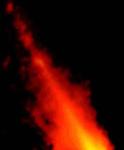
An unusual dust disk surrounds nearby star Beta Pictoris. Discovered in 1983, astronomers are still learning just how unusual this disk is. Recent images and computer simulations indicate that the disk contains several elliptical dust rings larger than our own Solar System.
 APOD: 2025 September 14 Б Planets of the Solar System: Tilts and Spins
13.09.2025
How does your favorite planet spin? Does it spin rapidly around a nearly vertical axis, or horizontally, or backwards? The featured video animates NASA images of all eight planets in our Solar System to show them spinning side-by-side for an easy comparison.
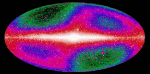 Stars in the Infrared Sky
18.09.1996
What if you could see infrared light? Because this light is less absorbed by dust than visible light, you could peer into the center of our Milky Way Galaxy. The stars there are normally hidden from direct view by the interstellar dust clouds which line the Galactic plane.
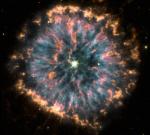 Celebrating Hubble With NGC 6751
16.04.2005
Planetary nebulae can look simple, round, and planet-like in small telescopes. But images from the orbiting Hubble Space Telescope have become well known for showing these fluorescent gas shrouds of dying Sun-like stars to possess a staggering variety of detailed symmetries and shapes.
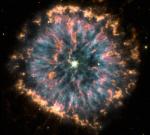 Celebrating Hubble With NGC 6751
7.04.2000
Planetary nebulae do look simple, round, and planet-like in small telescopes. But images from the orbiting Hubble Space Telescope have become well known for showing these fluorescent gas shrouds of dying Sun-like stars to possess a staggering variety of detailed symmetries and shapes.
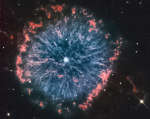 NGC 6751: The Glowing Eye Nebula
13.03.2013
Planetary nebulae can look simple, round, and planet-like in small telescopes. But images from the orbiting Hubble Space Telescope have become well known for showing these fluorescent gas shrouds of dying Sun-like stars to possess a staggering variety of detailed symmetries and shapes.
|
January February March April May June |
|||||||||||||||||||||||||||||||||||||||||||||||||