
|
You entered: star cluster
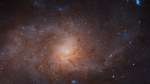 The Stars of the Triangulum Galaxy
23.02.2019
Like grains of sand on a cosmic beach, stars of the Triangulum Galaxy are resolved in this sharp mosaic from the Hubble Space Telescope's Advanced Camera for Surveys (ACS). The inner region of the galaxy spanning over 17,000 light-years is covered at extreme resolution, the second largest image ever released by Hubble.
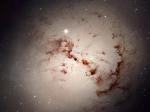 NGC 1316: After Galaxies Collide
4.04.2005
How did this strange-looking galaxy form? Astronomers turn detectives when trying to figure out the cause of unusual jumbles of stars, gas, and dust like NGC 1316. A preliminary inspection indicates that NGC 1316 is an enormous elliptical galaxy that includes dark dust lanes usually found in a spiral.
 APOD: 2023 December 13 Б Deep Field: The Heart Nebula
13.12.2023
What excites the Heart Nebula? First, the large emission nebula on the left, catalogued as IC 1805, looks somewhat like a human heart. The nebula glows brightly in red light emitted by its most prominent element, hydrogen, but this long-exposure image was also blended with light emitted by silicon (yellow) and oxygen (blue).
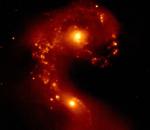 Antennae Galaxies in Near Infrared
11.04.2002
What happens when galaxies collide? One of the best studied examples of the jumble of star clusters, gas, and dust clouds produced by such a cosmic train wreck is the interacting galaxy pair NGC 4038 / NGC 4039, the Antennae Galaxies, only sixty million light-years away.
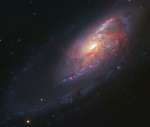 The Arms of M106
6.02.2013
The spiral arms of bright galaxy M106 sprawl through this remarkable multiframe portrait, composed of data from ground- and space-based telescopes. Also known as NGC 4258, M106 can be found toward the northern constellation Canes Venatici. The well-measured distance to M106 is 23.5 million light-years, making this cosmic scene about 80,000 light-years across.
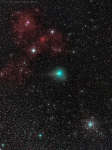 A Charioteer s Comet
1.03.2019
Still racing across planet Earth's night skies, Comet Iwamoto (C/2018 Y1) shares this pretty telescopic field of view with stars and nebulae of northern constellation Auriga, the Charioteer. Captured on February 27, Iwamoto's greenish coma and faint tail appear between a complex of reddish emission nebulae and open star cluster M36 (bottom right).
 Late Night Vallentuna
15.08.2024
Bright Mars and even brighter Jupiter are in close conjunction just above the pine trees in this post-midnight skyscape from Vallentuna, Sweden. Taken on August 12 during a geomagnetic storm, the snapshot records the glow of aurora borealis or northern lights, beaming from the left side of the frame.
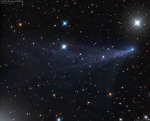 Blue Comet PanSTARRS
12.01.2018
Discovered with the PanSTARRS telescope on September 7, 2016, this Comet PanSTARRS, C/2016 R2, is presently about 24 light minutes (3 AU) from the Sun, sweeping through planet Earth's skies across the background of stars in the constellation Taurus.
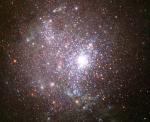 The Stars of NGC 1705
23.04.2003
Some 2,000 light-years across, NGC 1705 is small as galaxies go, similar to our Milky Way's own satellite galaxies, the Magellanic Clouds. At a much larger distance of 17 million light-years...
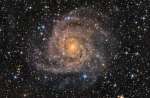 Hidden Galaxy IC 342
18.07.2013
Similar in size to large, bright spiral galaxies in our neighborhood, IC 342 is a mere 10 million light-years distant in the long-necked, northern constellation Camelopardalis. A sprawling island universe, IC 342 would otherwise...
|
January February March April May |
|||||||||||||||||||||||||||||||||||||||||||||||||