
|
You entered: sky
 APOD: 2023 September 27 Б STEVE and Milky Way Cross over Rural Road
27.09.2023
Not every road ends in a STEVE. A week ago, a sky enthusiast's journey began with a goal: to photograph an aurora over Lake Huron. Driving through rural Ontario, Canada, the forecasted sky show started unexpectedly early, causing the photographer to stop before arriving at the scenic Great Lake.
 APOD: 2025 September 12 Б Lunar Eclipse in Two Hemispheres
12.09.2025
September's total lunar eclipse is tracked across night skies from both the northern and southern hemispheres of planet Earth in these two dramatic timelapse series. In the northern hemisphere sequence (top panel) the MoonБs trail arcs from the upper left to the lower right.
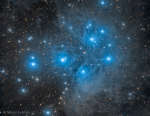 M45: The Pleiades Star Cluster
17.06.2015
Have you ever seen the Pleiades star cluster? Even if you have, you probably have never seen it as dusty as this. Perhaps the most famous star cluster on the sky, the bright stars of the Pleiades can be seen without binoculars from even the depths of a light-polluted city.
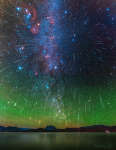 Geminids from Gemini
16.11.2021
Where are all of these meteors coming from? In terms of direction on the sky, the pointed answer is the constellation of Gemini. That is why the major meteor shower in December is known as the Geminids -- because shower meteors all appear to come from a radiant toward Gemini.
 Pleiades: The Seven Sisters Star Cluster
24.11.2021
Have you ever seen the Pleiades star cluster? Even if you have, you probably have never seen it as large and clear as this. Perhaps the most famous star cluster on the sky, the bright stars of the Pleiades can be seen without binoculars from even the depths of a light-polluted city.
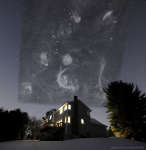 The Big Picture
11.04.2009
Intricate, glowing nebulae that shine in planet Earth's night sky are beautiful to look at in deep images made with telescopes and sensitive cameras. But they are faint and otherwise invisible to the naked-eye. That makes their relative location and extent on the sky difficult to appreciate.
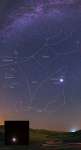 Opposite the Sun
18.09.2010
Chances are the brightest star you've seen lately is actually planet Jupiter. Jupiter rules the sky in this labeled view of a starry September night from the Alborz mountains in Iran, complete with the trail of a red flashlight illuminating the mountain road.
 Comet Tails and Star Trails
21.07.2015
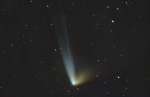
After grazing the western horizon on northern summer evenings Comet PanSTARRS (also known as C/2014 Q1) climbed higher in southern winter skies. A visitor to the inner Solar System discovered in August 2014 by the prolific panSTARRS survey, the comet was captured here on July 17.
 Harvest Moon Eclipse
23.09.2016
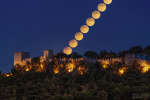
A Harvest Moon rises over Sesimbra Castle south of Lisbon in this impressive series of telephoto exposures. Captured at its full phase, the golden Moon was also gliding through the Earth's more diffuse outer shadow during September's penumbral lunar eclipse. The eclipse shading is subtle compared to a total lunar eclipse.
 The Gegenschein Over Chile
2.12.2012
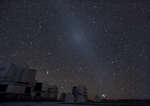
Is the night sky darkest in the direction opposite the Sun? No. In fact, a rarely discernable faint glow known as the gegenschein (German for "counter glow") can be seen 180 degrees around from the Sun in an extremely dark sky. The gegenschein is sunlight back-scattered off small interplanetary dust particles.
|
January February March April May June July August September October |
|||||||||||||||||||||||||||||||||||||||||||||||||