
|
You entered: image
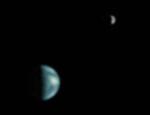 The Earth and Moon from Mars
26.05.2003
What does Earth look like from Mars? The first image of Earth from the red planet was captured earlier this month by the camera onboard the Mars Global Surveyor spacecraft currently orbiting Mars. Features visible on Earth include the Pacific Ocean, clouds, much of South America, and part of North America.
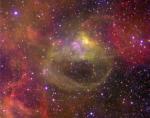 Energized Nebula in the LMC
10.04.2003
Blossoming in nearby galaxy the Large Magellanic Cloud (LMC), this gorgeous nebula is energized by radiation and winds from a massive star whose surface temperature approaches 100,000 degrees. The composite color image from...
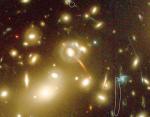 Galaxy Cluster Lenses Farthest Known Galaxy
16.02.2004
Gravity can bend light, allowing whole clusters of galaxies to act as huge telescopes. Almost all of the bright objects in this just-released Hubble Space Telescope image are galaxies in the cluster known as Abell 2218.
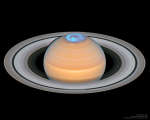 Aurora around Saturns North Pole
2.09.2018
Are Saturn's auroras like Earth's? To help answer this question, the Hubble Space Telescope and the Cassini spacecraft monitored Saturn's North Pole simultaneously during Cassini's final orbits around the gas giant in September 2017. During this time, Saturn's tilt caused its North Pole to be clearly visible from Earth.
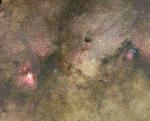 APOD: 2002 September 18- A Sagittarius Starscape
18.09.2002
Many vast star fields in the plane of our Milky Way Galaxy are rich in clouds of stars, dust, and gas. First and foremost, visible in the above picture are millions of stars, many of which are similar to our Sun.
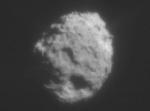 Comet Wild 2s Nucleus from Stardust
2.01.2004
What does a comet nucleus look like? Yesterday the robot spacecraft Stardust answered this question by returning the most detailed images yet of the center of a comet. The icy centers of comets are usually hidden from Earth-bound telescopes by opaque dust and gas that boils off during approach to the Sun.
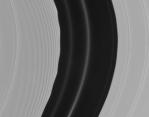 The Encke Gap: A Moon Goes Here
2.07.2004
Yesterday, Cassini became the first spacecraft to enter orbit around the gas giant Saturn, rocketing through a 25,000 kilometer wide gap in the distant planet's magnificent system of icy rings at about 15 kilometers per second.
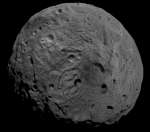 The South Pole of Asteroid Vesta
19.09.2011
What created the circular structure around the south pole of asteroid Vesta? Pictured above, the bottom of the second largest object in the asteroid belt was recently imaged for the first time by the robotic Dawn satellite that arrived last month.
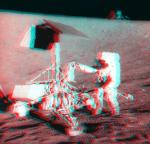 Apollo Surveyor Stereo View
9.03.2001
Put on your red/blue glasses and gaze into this dramatic stereo view from the surface of the Moon! Inspired by last Saturday's APOD, Patrick Vantuyne offers this stereo rendering of the captivating picture of Apollo 12 astronaut Pete Conrad visiting the Surveyor
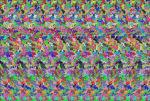 The Holographic Principle
30.04.2002
Is this image worth a thousand words? According to the Holographic Principle, the most amount of information you can get from this image is about 3 x 1065 bits for a normal sized computer monitor.
|
January February March April May June July August September |
|||||||||||||||||||||||||||||||||||||||||||||||||