
|
You entered: star system
 Beta Pictoris Revisited
28.11.1997
In the early 1980s, Beta Pictoris became one of the most important stars in the sky. Satellite and ground-based telescopic observations revealed the presence of a surrounding outer disk of material and an inner "clear" zone about the size of our solar system - strong evidence for the formation of planets.
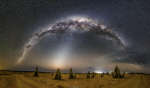 Milky Way and Zodiacal Light over Australian Pinnacles
23.10.2022
What strange world is this? Earth. In the foreground of the featured image are the Pinnacles, unusual rock spires in Nambung National Park in Western Australia. Made of ancient sea shells (limestone), how these human-sized picturesque spires formed remains a topic of research. The picturesque panorama was taken in 2017 September.
 Milky Way and Zodiacal Light over Australian Pinnacles
10.10.2017
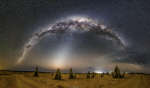
What strange world is this? Earth. In the foreground of the featured image are the Pinnacles, unusual rock spires in Nambung National Park in Western Australia. Made of ancient sea shells (limestone), how these human-sized picturesque spires formed remains a topic of research. The panorama was taken last month.
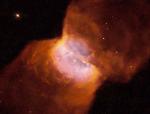 NGC 2346: A Butterfly-Shaped Planetary Nebula
28.10.2001
It may look like a butterfly, but it's bigger than our Solar System. NGC 2346 is a planetary nebula made of gas and dust that has evolved into a familiar shape. At the heart of the bipolar planetary nebula is a pair of close stars orbiting each other once every sixteen days.
 NGC 2346: A Butterfly Shaped Planetary Nebula
12.10.1999
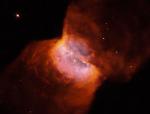
It may look like a butterfly, but it's bigger than our Solar System. NGC 2346 is a planetary nebula made of gas and dust that has evolved into a familiar shape. At the heart of the bipolar planetary nebula is a pair of close stars orbiting each other once every sixteen days.
 Comet Hyakutake's Past and Future
23.03.1996
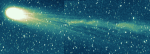
The above false-color picture of Comet Hyakutake taken just two days ago shows its rapidly developing tail. The comet now has a substantial coma with a bright center, lending it a dramatic eye-like appearance. This is not Comet Hyakutake's first visit to the inner Solar System.
 Sh2-239: Celestial Impasto
8.12.2011
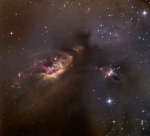
The cosmic brush of star formation composed this alluring mix of dust and dark nebulae. Cataloged as Sh2-239 and LDN 1551, the region lies near the southern end of the Taurus molecular cloud complex some 450 light-years distant.
 Stardust and Betelgeuse
28.06.2011
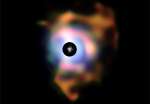
An expansive nebula of dust is seen to surround red supergiant star Betegeuse in this remarkable high resolution composite, an infrared VLT image from the European Southern Observatory. Betelgeuse itself is outlined by the small, central red circle. If found in our own solar system its diameter would almost encompass the orbit of Jupiter.
 Unexplained Dimmings in KIC 8462852
13.06.2016
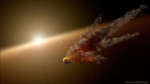
Why does star KIC 8462852 keep wavering? Nobody knows. A star somewhat similar to our Sun, KIC 8462852 was one of many distant stars being monitored by NASA's robotic Kepler satellite to see if it had planets.
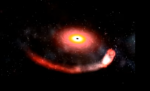 Unusual Signal Suggests Neutron Star Destroyed by Black Hole
3.09.2019
What created this unusual explosion? Three weeks ago, gravitational wave detectors in the USA and Europe -- the LIGO and Virgo detectors -- detected a burst of gravitational radiation that had the oscillating pattern expected when a black hole destroys a neutron star.
|
January February March April May June |
|||||||||||||||||||||||||||||||||||||||||||||||||