
|
You entered: star cluster
 Mars Over the Allalinhorn
8.03.2010
What's that bright object in the sky? A common question with answers that vary by time and season, the quick answer just after sunset in middle of last month, from the norther hemisphere, was Mars.
 A Primodrial Quasar
20.05.2003
What did the first quasars look like? The nearest quasars are now known to be supermassive black holes in the centers of galaxies. Gas and dust that falls toward a quasar glows brightly, sometimes outglowing the entire home galaxy.
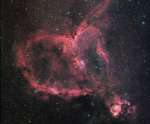 IC 1805: The Heart Nebula
14.02.2009
Sprawling across almost 200 light-years, emission nebula IC 1805 is a mix of glowing interstellar gas and dark dust clouds. Derived from its Valentine's-Day-approved shape, its nickname is the Heart Nebula. About 7,500 light-years away in the Perseus spiral arm of our galaxy, stars were born in IC 1805.
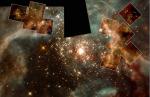 Massive Stars Of 30 Doradus
30.09.1999
This gorgeous visible-light Hubble Space Telescope image shows a young cluster of massive stars at the center of the 30 Doradus Nebula. Gas and dust clouds in 30 Doradus, also known as the Tarantula Nebula, have been sculpted into elongated shapes by powerful winds and ultraviolet radiation from these hot cluster stars.
 APOD: 2025 August 19 Б Giant Galaxies in Pavo
19.08.2025
Over 500,000 light years across, NGC 6872 (bottom left) is a truly enormous barred spiral galaxy. At least 5 times the size of our own large Milky Way, NGC 6872 is the largest known spiral galaxy.
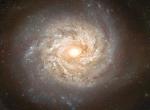 Spiral Galaxy NGC 3982 Before Supernova
3.11.2003
What do stars look like just before they explode? To find out, astronomers are taking detailed images of nearby galaxies now, before any supernova is visible. Hopefully, a star in one of the hundreds of high resolution galaxy images will explode in the coming years.
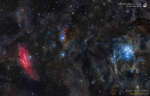 From California to the Pleiades
22.11.2013
An astronomical trip from the California Nebula to the Pleiades star cluster would cover just 12 degrees across planet Earth's night sky. That's equivalent to the angular extent of 25 Full Moons, as your telescope sweeps over the borders of the constellations Perseus and Taurus.
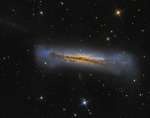 Edge on NGC 3628
4.11.2011
Sharp telescopic views of magnificent edge-on spiral galaxy NGC 3628 show a puffy galactic disk divided by dark dust lanes. The tantalizing scene puts many astronomers in mind of its popular moniker, The Hamburger Galaxy.
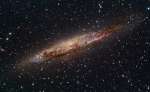 Nearby Spiral Galaxy NGC 4945
23.01.2013
Large spiral galaxy NGC 4945 is seen edge-on near the center of this cosmic galaxy portrait. In fact, NGC 4945 is almost the size of our own Milky Way Galaxy. Its own dusty disk, young blue star clusters, and pink star forming regions standout in the sharp, colorful telescopic image.
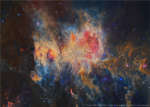 Infrared Orion from WISE
18.01.2015
The Great Nebula in Orion is an intriguing place. Visible to the unaided eye, it appears as a small fuzzy patch in the constellation of Orion. But this image, an illusory-color four-panel mosaic taken...
|
January February March April May |
|||||||||||||||||||||||||||||||||||||||||||||||||