
|
You entered: Earth orbit
 APOD: 2024 February 4 Б The Cone Nebula from Hubble
3.02.2024
Stars are forming in the gigantic dust pillar called the Cone Nebula. Cones, pillars, and majestic flowing shapes abound in stellar nurseries where natal clouds of gas and dust are buffeted by energetic winds from newborn stars. The Cone Nebula, a well-known example, lies within the bright galactic star-forming region NGC 2264.
 GRB 221009A
14.10.2022
Gamma-ray burst GRB 221009A likely signals the birth of a new black hole, formed at the core of a collapsing star long ago in the distant universe. The extremely powerful blast is depicted in this animated gif constructed using data from the Fermi Gamma Ray Space Telescope.
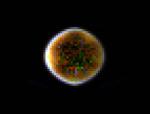 Gamma Ray Earth
31.03.2005
The pixelated planet above is actually our own planet Earth seen in gamma rays - the most energetic form of light. In fact, the gamma rays used to construct this view pack over 35 million electron volts (MeV) compared to a mere two electron volts (eV) for a typical visible light photon.
 Perihelion Approaches
14.08.2015
This dramatic outburst from the nucleus of Comet 67P/Churyumov-Gerasimenko occured on August 12, just hours before perihelion, its closest approach to the Sun. Completing an orbit of the Sun once every 6.45 years, perihelion distance for this periodic comet is about 1.3 astronomical units (AU), still outside the orbit of planet Earth (at 1 AU).
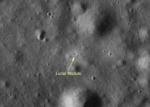 Lunar Module at Taurus Littrow
28.06.2002
Can the Hubble Space Telescope take a picture that shows the Apollo lunar modules on the Moon? With its 2.4 meter diameter mirror, the smallest object that the Hubble can resolve at the Moon's distance of around 400,000 kilometers is about 80 meters across.
 Saturn at Night
1.11.2024
Saturn is bright in Earth's night skies. Telescopic views of the outer gas giant planet and its beautiful rings often make it a star at star parties. But this stunning view of Saturn's rings and night side just isn't possible from telescopes in the vicinity of planet Earth.
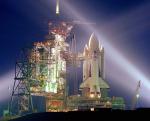 STS 1: First Shuttle Launch
12.04.2001
On April 12, 1981, twenty years ago today, the Space Shuttle Columbia became the first shuttle to orbit the Earth. In this gorgeous time exposure, flood lights play on the Columbia and service structures (left) as it rests atop Complex 39's Pad A at Kennedy Space Center in preparation for first launch.
 Hubble Floats Free
25.05.2009
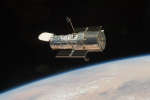
Why put observatories in space? Most telescopes are on the ground. On the ground, you can deploy a heavier telescope and fix it more easily. The trouble is that Earth-bound telescopes must look through the Earth's atmosphere.
 The First Image of an Extra Solar Planet
10.05.2005
It's the faint red object, not the bright white one that might be a historic find. The white object is surely a brown dwarf star. Quite possibly, however, the red object is the first direct image of a planet beyond our Solar System.
 Molecular Torus Surrounds Black Hole
8.09.2004
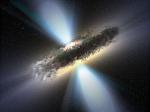
Why do some black hole surroundings appear brighter than others? In the centers of active galaxies, supermassive black holes at least thousands of times the mass of our Sun dominate. Many, called Seyfert Type I, are very bright in visible light. Others, called Seyfert Type II, are rather dim.
|
January February March April May June July August |
||||||||||||||||||||||||||||||||||||||||||||||||||||||||