
|
You entered: dust cloud
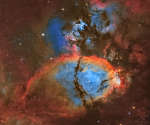 IC 1795: The Fishhead Nebula
31.07.2019
To some, this nebula looks like the head of a fish. However, this colorful cosmic portrait really features glowing gas and obscuring dust clouds in IC 1795, a star forming region in the northern constellation Cassiopeia.
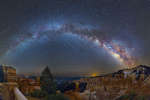 Meteors, Planes, and a Galaxy over Bryce Canyon
19.05.2014
Sometimes land and sky are both busy and beautiful. The landscape pictured in the foreground encompasses Bryce Canyon in Utah, USA, famous for its many interesting rock structures eroded over millions of years.
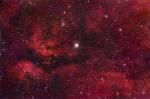 Central Cygnus
4.01.2007
Supergiant star Gamma Cygni lies at the center of the Northern Cross, famous asterism in the constellation Cygnus the Swan. Known by the proper name Sadr, the bright star also lies at the center...
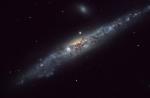 NGC 4631: The Whale Galaxy
29.03.2002
NGC 4631 is a big beautiful spiral galaxy seen edge-on only 25 million light-years away towards the small northern constellation Canes Venatici. This galaxy's slightly distorted wedge shape suggests to some a cosmic herring and to others the popular moniker of The Whale Galaxy.
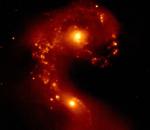 Antennae Galaxies in Near Infrared
11.04.2002
What happens when galaxies collide? One of the best studied examples of the jumble of star clusters, gas, and dust clouds produced by such a cosmic train wreck is the interacting galaxy pair NGC 4038 / NGC 4039, the Antennae Galaxies, only sixty million light-years away.
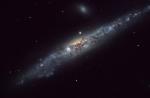 NGC 4631: The Whale Galaxy
23.01.2004
NGC 4631 is a big beautiful spiral galaxy seen edge-on only 25 million light-years away towards the small northern constellation Canes Venatici. This galaxy's slightly distorted wedge shape suggests to some a cosmic herring and to others the popular moniker of The Whale Galaxy.
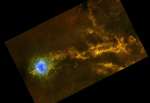 Herschel s Cocoon
19.08.2011
In this remarkable infrared skyscape of interstellar clouds adrift in the high flying constellation Cygnus, the eye is drawn to the Cocoon Nebula. Also known as IC5146, the dusty star forming region is shown...
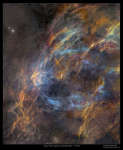 Cygnus Shell Supernova Remnant W63
2.11.2018
The ghost of a long-dead star, the W63 supernova remnant shines like a faint cosmic smoke-ring along the plane of the Milky Way galaxy toward the northern constellation Cygnus the swan. Its wraithlike appearance is traced against the region's rich complex of interstellar clouds and dust by an eerie blue glow.
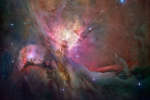 Orion Nebula: The Hubble View
22.02.2009
Few cosmic vistas excite the imagination like the Orion Nebula. Also known as M42, the nebula's glowing gas surrounds hot young stars at the edge of an immense interstellar molecular cloud only 1,500 light-years away.
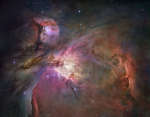 Orion Nebula: The Hubble View
15.07.2012
Few cosmic vistas excite the imagination like the Orion Nebula. Also known as M42, the nebula's glowing gas surrounds hot young stars at the edge of an immense interstellar molecular cloud only 1,500 light-years away.
|
January February March April May June July August September |
|||||||||||||||||||||||||||||||||||||||||||||||||