
|
You entered: Observatory
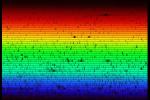 The Solar Spectrum
27.02.2005
It is still not known why the Sun's light is missing some colors. Shown above are all the visible colors of the Sun, produced by passing the Sun's light through a prism-like device.
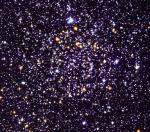 NGC 7789: Galactic Star Cluster
9.07.1999
At 1.6 billion years old, this cluster of stars is beginning to show its age. NGC 7789 is an open or galactic star cluster about 8,000 light-years distant toward the constellation Cassiopeia and lies near the plane of our Milky Way galaxy.
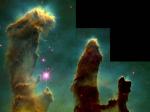 M16: Pillars of Creation
18.02.2007
It has become one of the most famous images of modern times. This image, taken with the Hubble Space Telescope in 1995, shows evaporating gaseous globules (EGGs) emerging from pillars of molecular hydrogen gas and dust.
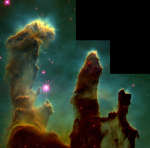 M16: Pillars of Creation
28.03.2010
It has become one of the most famous images of modern times. This image, taken with the Hubble Space Telescope in 1995, shows evaporating gaseous globules (EGGs) emerging from pillars of molecular hydrogen gas and dust.
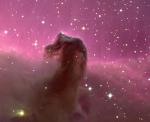 The Horsehead Nebula
19.05.1999
One of the most identifiable nebulae in the sky, the Horsehead Nebula in Orion, is part of a large, dark, molecular cloud. Also known as Barnard 33, the unusual shape was first discovered on a photographic plate in the late 1800s.
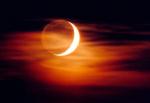 The Old Moon in the New Moon's Arms
19.04.2002
Also known as the Moon's "ashen glow" or "the old Moon in the new Moon's arms", Earthshine is Earthlight reflected from the Moon's night side. This dramatic image of Earthshine...
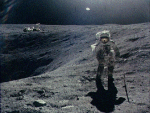 Apollo 16: Exploring Plum Crater
20.12.1997
Apollo 16 spent three days on Earth's Moon in April 1972. The fifth lunar landing mission out of six, Apollo 16 was famous for deploying and using an ultraviolet telescope as the first lunar observatory, and for collecting rocks and data on the mysterious lunar highlands. In the above picture, astronaut John W.
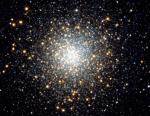 Hydrogen, Helium, and the Stars of M10
12.03.1999
Stars like the Sun use hydrogen for fuel, "burning" hydrogen into helium at their cores through nuclear fusion. But what happens when that hydrogen runs out? For a while, hydrogen burns in a shell surrounding the stellar core and the star expands to become a red giant.
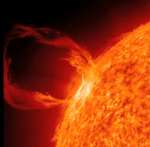 Large Eruptive Prominence Imaged by SDO
10.05.2010
Sometimes part of the Sun can just explode into space. These explosions might occur as powerful solar flares, coronal mass ejections, or comparatively tame eruptive solar prominences. Pictured above is one of the largest solar prominence eruptions yet observed, one associated with a subsequent coronal mass ejection.
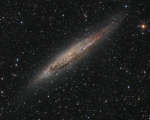 Nearby Spiral Galaxy NGC 4945
28.05.2015
Large spiral galaxy NGC 4945 is seen edge-on near the center of this cosmic galaxy portrait. In fact, NGC 4945 is almost the size of our own Milky Way Galaxy. Its own dusty disk, young blue star clusters, and pink star forming regions standout in the sharp, colorful telescopic image.
|
January February March April May June July August September October |
|||||||||||||||||||||||||||||||||||||||||||||||||