
|
You entered: Earth orbit
 The Local Fluff
24.09.2013
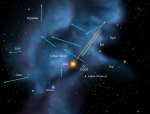
The stars are not alone. In the disk of our Milky Way Galaxy about 10 percent of visible matter is in the form of gas, called the interstellar medium (ISM). The ISM is not uniform, and shows patchiness even near our Sun.
 CMBR Dipole: Speeding Through the Universe
9.03.2008
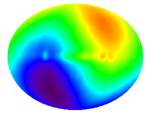
Our Earth is not at rest. The Earth moves around the Sun. The Sun orbits the center of the Milky Way Galaxy. The Milky Way Galaxy orbits in the Local Group of Galaxies. The Local Group falls toward the Virgo Cluster of Galaxies.
 CMBR Dipole: Speeding Through the Universe
6.09.2009
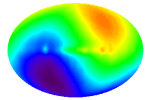
Our Earth is not at rest. The Earth moves around the Sun. The Sun orbits the center of the Milky Way Galaxy. The Milky Way Galaxy orbits in the Local Group of Galaxies. The Local Group falls toward the Virgo Cluster of Galaxies.
 HESS Telescopes Explore the High Energy Sky
8.01.2019
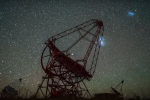
They may look like modern mechanical dinosaurs but they are enormous swiveling eyes that watch the sky. The High Energy Stereoscopic System (H.E.S.S.) Observatory is composed of four 12-meter reflecting-mirror telescopes surrounding a larger telescope housing a 28-meter mirror.
 APOD: 2023 September 6 Б HESS Telescopes Explore the High Energy Sky
6.09.2023
They may look like modern mechanical dinosaurs, but they are enormous swiveling eyes that watch the sky. The High Energy Stereoscopic System (H.E.S.S.) Observatory is composed of four 12-meter reflecting-mirror telescopes surrounding a larger telescope housing a 28-meter mirror.
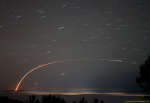 OCO 2 Night Launch
4.07.2014
In this alluring time exposure, star trails arc across the night sky above foggy Monterey Bay and the lights of Santa Cruz, California in the United States of America. Since the exposure began around...
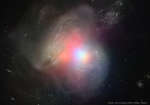 Arp 299: Black Holes in Colliding Galaxies
1.11.2016
Is only one black hole spewing high energy radiation -- or two? To help find out, astronomers trained NASA's Earth-orbiting NuSTAR and Chandra telescopes on Arp 299, the enigmatic colliding galaxies expelling the radiation.
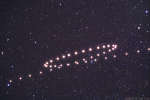 Retrograde Mars
13.06.2010
Why would Mars appear to move backwards? Most of the time, the apparent motion of Mars in Earth's sky is in one direction, slow but steady in front of the far distant stars. About every two years, however, the Earth passes Mars as they orbit around the Sun.
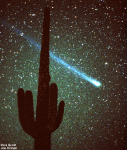 Comet Hyakutake and a Cactus
1.05.1996
Comet Hyakutake is shown photographed the night of March 27 in Arizona, USA, with a cactus in the foreground. Polaris, the north star, is the bright star seen just to the upper right of the comet's head. Today Comet Hyakutake reaches its closest approach to the Sun.
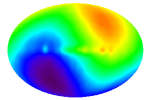 CMB Dipole: Speeding Through the Universe
15.06.2014
Our Earth is not at rest. The Earth moves around the Sun. The Sun orbits the center of the Milky Way Galaxy. The Milky Way Galaxy orbits in the Local Group of Galaxies. The Local Group falls toward the Virgo Cluster of Galaxies.
|
January February March April May June July August |
||||||||||||||||||||||||||||||||||||||||||||||||||||||||