
|
You entered: Earth's moon
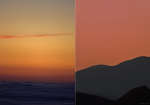 Two Views, Two Crescents
11.11.2010
Venus rose in a glowing dawn sky on November 5th, just before the Sun. For early morning risers, its brilliant crescent phase was best appreciated with binoculars or a small telescope. On that...
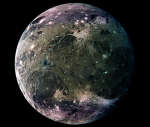 Ganymede Enhanced
20.09.2009
What does the largest moon in the Solar System look like? Ganymede, larger than even Mercury and Pluto, has a surface speckled with bright young craters overlying a mixture of older, darker, more cratered terrain laced with grooves and ridges.
 Mountains of Titan
14.12.2006
Peering through the thick, hazy atmosphere of Saturn's largest moon, an infrared camera onboard the Cassini spacecraft recorded this view of the tallest mountains ever seen on Titan. Captured during a flyby...
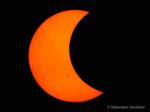 Solstice And Season's Eclipse
21.12.2000
Today the Sun reaches its southernmost point in planet Earth's sky at 13:37 UT. This celestial event is known as a solstice, marking the beginning of Summer in the Southern Hemisphere and Winter in the North.
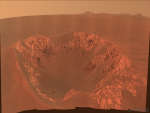 Intrepid Crater on Mars from Opportunity
4.04.2018
The robotic rover Opportunity sometimes passes small craters on Mars. Pictured here in 2010 is Intrepid Crater, a 20-meter across impact basin slightly larger than Nereus Crater that Opportunity had chanced across previously. The featured image is in approximately true color but horizontally compressed to accommodate a wide angle panorama.
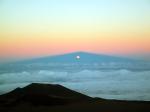 Moonrise Through Mauna Keas Shadow
3.12.2003
How can the Moon rise through a mountain? It cannot -- what was photographed here is a moonrise through the shadow of a large volcano. The volcano is Mauna Kea, Hawai'i, USA, a frequent spot for spectacular photographs since it is arguably the premier observing location on planet Earth.
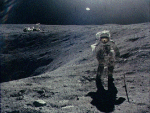 Apollo 16: Exploring Plum Crater
7.06.1996
Apollo 16 spent three days on Earth's Moon in April 1972. The fifth lunar landing mission out of six, Apollo 16 was famous for deploying and using an ultraviolet telescope as the first lunar observatory, and for collecting rocks and data on the mysterious lunar highlands. In the above picture, astronaut John W.
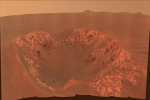 Intrepid Crater on Mars
8.12.2010
The robotic rover Opportunity has chanced across another small crater on Mars. Pictured above is Intrepid Crater, a 20-meter across impact basin slightly larger than Nereus Crater that Opportunity chanced across last year. The above image is in approximately true color but horizontally compressed to accommodate a wide angle panorama.
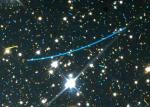 Asteroids in the Distance
23.06.2002
Rocks from space hit Earth every day. The larger the rock, though, the less often Earth is struck. Many kilograms of space dust pitter to Earth daily. Larger bits appear initially as a bright meteor. Baseball-sized rocks and ice-balls streak through our atmosphere daily, most evaporating quickly to nothing.
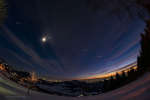 Planetary Alignment over Italy
19.12.2021
It is not a coincidence that planets line up. That's because all of the planets orbit the Sun in (nearly) a single sheet called the plane of the ecliptic. When viewed from inside that plane -- as Earth dwellers are likely to do -- the planets all appear confined to a single band.
|
January February March April May June July August September |
|||||||||||||||||||||||||||||||||||||||||||||||||