
|
You entered: Earth
 Islands of Four Mountains from Above
22.06.2010
Our Earth is covered by volcanoes. Volcanoes are breaks in the Earth's cool surface where hot liquid rock from the interior comes out -- sometimes suddenly. In the above image from the ASTER camera...
 APOD: 2023 April 19 Б Auroral Storm over Lapland
19.04.2023
On some nights the sky is the best show in town. On this night, auroras ruled the sky, and the geomagnetic storm that created this colorful sky show originated from an increasingly active Sun.
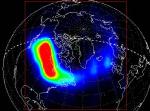 Solar Storm Causes X-Ray Aurora
18.04.1997
On April 7, the SOHO spacecraft spotted a Solar Storm ejecting a cloud of energetic particles toward planet Earth. The plasma cloud's center missed Earth, but high energy particles swept up by Earth's magnetosphere still created a geomagnetic storm!
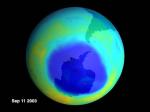 A Near Record Ozone Hole in 2003
6.10.2003
As expected, the ozone hole near Earth's South Pole is back again this year. This year's hole, being slightly larger than North America, is larger than last year but short of the record set on 2000 September 10. Ozone is important because it shields us from damaging ultraviolet sunlight.
 CMBR Dipole: Speeding Through the Universe
8.05.2005
Our Earth is not at rest. The Earth moves around the Sun. The Sun orbits the center of the Milky Way Galaxy. The Milky Way Galaxy orbits in the Local Group of Galaxies. The Local Group falls toward the Virgo Cluster of Galaxies.
 A Panorama from Mauna Kea
4.07.2005
Typically, views from Mauna Kea are up and dark. That's because the famous dormant volcano in Hawaii is arguably Earth's premier observing platform of the complex and ever changing night sky. However, this daytime view is across and bright. White snow and white clouds seem to blend together to make an alien landscape.
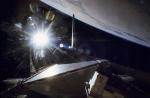 The Equal Night
23.09.2007
Today, the Sun crosses the celestial equator heading south at 0951 UT. Known as the equinox, the astronomical event marks the first day of autumn in the northern hemisphere and spring in the south.
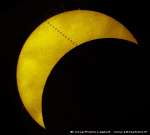 A Double Eclipse of the Sun
21.03.2015
Can the Sun be eclipsed twice at the same time? Last Friday was noteworthy because part of the Earth was treated to a rare total eclipse of the Sun. But also on Friday, from...
 APOD: 2023 June 21 Б Three Sun Paths
21.06.2023
Does the Sun follow the same path every day? No. The Sun's path changes during the year, tracing a longer route during the summer than the winter. Pictured here...
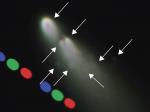 Crumbling Comet Schwassmann Wachmann 3 Approaches
26.04.2006
A crumbling comet will soon pass near the Earth. Comet 73P/Schwassmann-Wachmann 3 is brightening and may even be visible to the unaided eye when the fragmented comet zooms past Earth during the middle of next month.
|
January February March April May June July August September October |
|||||||||||||||||||||||||||||||||||||||||||||||||