
|
You entered: rocks
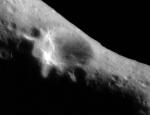 Eros From Orbit
15.02.2000
On February 14th, the NEAR spacecraft became the first artificial moon of an asteroid. Captured by the gentle gravity of a 20 mile long slipper-shaped mountain of rock, NEAR recorded this premier image while orbiting asteroid 433 Eros at a distance of about 200 miles.
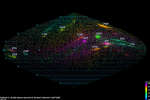 Forty Thousand Meteor Origins Across the Sky
11.05.2009
Where do meteors come from? Visible meteors are typically sand-sized grains of ice and rock that once fragmented from comets. Many a meteor shower has been associated with a known comet, although some intriguing orphan showers do remain.
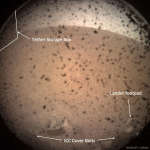 InSights First Image from Mars
26.11.2018
Welcome to Mars, NASA Insight. Yesterday NASA's robotic spacecraft InSight made a dramatic landing on Mars after a six-month trek across the inner Solar System. Needing to brake from...
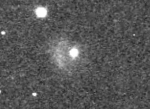 Expanding Plume from DARTs Impact
4.10.2022
What happens if you crash a spaceship into an asteroid? In the case of NASA's DART spaceship and the small asteroid Dimorphos, as happened last week, you get quite a plume. The goal...
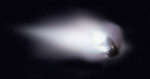 Comet Halleys Nucleus: An Orbiting Iceberg
3.01.2010
What does a comet nucleus look like? Formed from the primordial stuff of the Solar System, comet nuclei were thought to resemble very dirty icebergs. But ground-based telescopes revealed only the surrounding cloud of gas and dust of active comets nearing the Sun, clearly resolving only the comet's coma, and the characteristic cometary tails.
 Fireball!
25.02.1996
On rare but spectacular occasions, fireballs, meteors brighter than the brightest stars, flash through the heavens - sometimes making audible sounds and occasionally surviving to strike the Earth's surface. The path of one such...
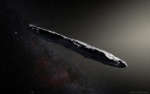 APOD: 2017 November 22 Oumuamua: Interstellar Asteroid
21.11.2017
Nothing like it has ever been seen before. The unusual space rock 'Oumuamua is so intriguing mainly because it is the first asteroid ever detected from outside our Solar System -- although likely many more are to follow given modern computer-driven sky monitoring.
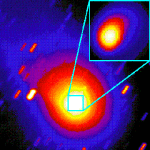 Periodic Comet Swift-Tuttle
18.02.1996
Comet Swift-Tuttle, shown above in false color, is the largest object known to make repeated passes near the Earth. It is also one of the oldest known periodic comets with sightings spanning two millennia.
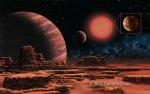 Gliese 876 System Includes Large Terrestrial Planet
14.06.2005
Is our Earth unique? In continuing efforts to answer this question, astronomers have now discovered an Earth-like planet orbiting a distant normal star. Previously over 150 gas-giant planets like Jupiter had been so discovered.
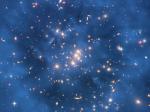 Dark Matter Ring Modeled around Galaxy Cluster CL0024 17
16.05.2007
How do we know that dark matter isn't just normal matter exhibiting strange gravity? A new observation of gravitationally magnified faint galaxies far in the distance behind a massive cluster of galaxies is shedding new dark on the subject.
|
January February March April May June July August September |
|||||||||||||||||||||||||||||||||||||||||||||||||