
|
You entered: nearest stars
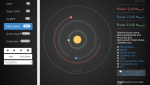 Super Planet Crash
11.01.2015
Can you create a planetary system that lasts for 500 years? Super Planet Crash, the featured game, allows you to try. To create up to ten planets, just click anywhere near the central star.
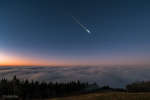 Good Morning Leonid
23.11.2018
On November 17, just an hour before sunrise, this bright and colorful meteor flashed through clear predawn skies. Above a sea of clouds this striking autumn morning's moment was captured from Hochblauen, a prominent 1165 meter high summit in southern Germany's Black Forest.
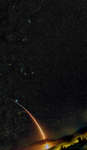 Launch to Lovejoy
21.01.2015
Blasting skyward an Atlas V rocket carrying a U.S. Navy satellite pierces a cloud bank in this starry night scene captured on January 20. On its way to orbit from Space Launch Complex...
 The Bubble and M52
8.10.2013
To the eye, this cosmic composition nicely balances the Bubble Nebula at the lower left with open star cluster M52 above it and to the right. The pair would be lopsided on other scales, though.
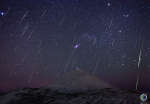 Geminid Meteors over Teide Volcano
17.12.2013
On some nights it rains meteors. Peaking two nights ago, asteroid dust streaked through the dark skies of Earth, showering down during the annual Geminids meteor shower. Astrophotographer Juan Carlos Casado captured the space weather event, as pictured above, in a series of exposures spanning about 2.3 hours using a wide angle lens.
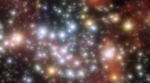 Journey to the Center of the Galaxy
29.07.2018
What wonders lie at the center of our Galaxy? In Jules Verne's science fiction classic A Journey to the Center of the Earth, Professor Liedenbrock and his fellow explorers encounter many strange and exciting wonders.
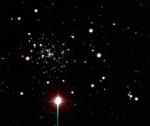 Palomar 13's Last Stand
30.11.2000
Globular star cluster Palomar 13 has roamed the halo of our Milky Way Galaxy for the last 12 billion years. The apparently sparse cluster of stars just left of center in this composite color digital image, it is one of the smallest, faintest globular clusters known.
 APOD: 2023 October 18 Б Dust and the Western Veil Nebula
18.10.2023
It's so big it is easy to miss. The entire Veil Nebula spans six times the diameter of the full moon, but is so dim you need binoculars to see it. The nebula was created about 15,000 years ago when a star in the constellation of the Swan (Cygnus) exploded.
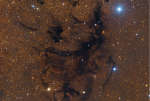 LDN 673: Dark Clouds in Aquila
29.10.2022
Part of a dark expanse that splits the crowded plane of our Milky Way galaxy, the Aquila Rift arcs through planet Earth's skies near bright star Altair. In eerie silhouette against the Milky...
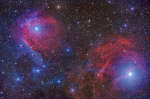 Scorpius in Red and Blue
25.05.2012
Cosmic dust clouds dim the light of background stars. But they also reflect the light of stars nearby. Since bright stars tend to radiate strongly in the blue portion of the visible spectrum, and the interstellar dust scatters blue light more strongly than red, the dusty reflection nebulae tend to be blue.
|
January February March April May June July August September October |
|||||||||||||||||||||||||||||||||||||||||||||||||