
|
You entered: hot star
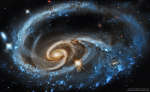 UGC 1810: Wildly Interacting Galaxy from Hubble
18.10.2020
What's happening to this spiral galaxy? Although details remain uncertain, it surely has to do with an ongoing battle with its smaller galactic neighbor. The featured galaxy is labelled UGC 1810 by itself, but together with its collisional partner is known as Arp 273.
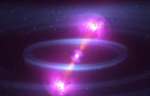 GW170817: A Spectacular Multiradiation Merger Event Detected
16.10.2017
Both gravitational and electromagnetic radiations have been detected in rapid succession for an explosive merging event for the first time. Data from the outburst fit well with a spectacular binary neutron-star death-spiral. The explosive episode was seen on August 17 in nearby NGC 4993, an elliptical galaxy only 130 million light years distant.
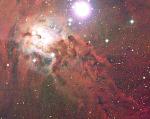 The Fox Fur Nebula
1.07.2002
The nebula surrounding bright star S Mon is filled with dark dust and glowing gas. The strange shapes that surrounding this star originate from fine interstellar dust reacting in complex ways with the energetic light and hot gas being expelled by the young stars.
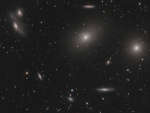 In the Heart of the Virgo Cluster
8.07.2008
The Virgo Cluster of Galaxies is the closest cluster of galaxies to our Milky Way Galaxy. The Virgo Cluster is so close that it spans more than 5 degrees on the sky - about 10 times the angle made by a full Moon.
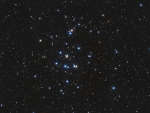 M44: The Beehive Cluster
22.02.2014
A mere 600 light-years away, M44 is one of the closest star clusters to our solar system. Also known as the Praesepe or the Beehive cluster its stars are young though, about 600 million years old compared to our Sun's 4.5 billion years.
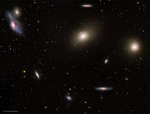 In the Heart of the Virgo Cluster
7.04.2015
The Virgo Cluster of Galaxies is the closest cluster of galaxies to our Milky Way Galaxy. The Virgo Cluster is so close that it spans more than 5 degrees on the sky - about 10 times the angle made by a full Moon.
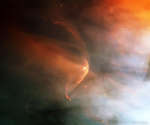 LL Orionis: When Cosmic Winds Collide
22.05.2016
What created this great arc in space? This arcing, graceful structure is actually a bow shock about half a light-year across, created as the wind from young star LL Orionis collides with the Orion Nebula flow.
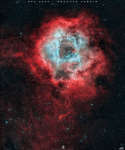 Roses are Red
14.02.2026
Roses are red, nebulas are too, and this Valentine's gift is a stunning view! Pictured is a loving look at the Rosette Nebula (NGC 2237): a cosmic bloom of bright young stars sitting atop a stem of glowing hot gas.
 IC 443: Supernova Remnant and Neutron Star
2.06.2006
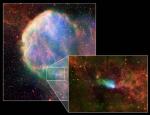
IC 443 is typical of the aftermath of a stellar explosion, the ultimate fate of massive stars. Seen in this false-color composite image, the supernova remnant is still glowing across the spectrum, from radio...
 APOD: 2020 August 31 Б SS 433: Binary Star Micro Quasar
31.08.2020
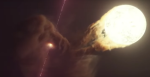
SS 433 is one of the most exotic star systems known. Its unremarkable name stems from its inclusion in a catalog of Milky Way stars which emit radiation characteristic of atomic hydrogen. Its remarkable behavior stems from a compact object, a black hole or neutron star, which has produced an accretion disk with jets.
|
January February |
|||||||||||||||||||||||||||||||||||||||||||||||||