
|
You entered: emission nebula
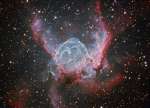 Thor s Helmet
5.06.2010
This helmet-shaped cosmic cloud with wing-like appendages is popularly called Thor's Helmet. Heroically sized even for a Norse god, Thor's Helmet is about 30 light-years across. In fact, the helmet is actually...
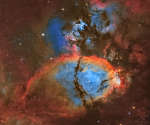 IC 1795: The Fishhead Nebula
31.07.2019
To some, this nebula looks like the head of a fish. However, this colorful cosmic portrait really features glowing gas and obscuring dust clouds in IC 1795, a star forming region in the northern constellation Cassiopeia.
 APOD: 2024 May 1 Б IC 1795: The Fishhead Nebula
1.05.2024
To some, this nebula looks like the head of a fish. However, this colorful cosmic portrait really features glowing gas and obscuring dust clouds in IC 1795, a star forming region in the northern constellation Cassiopeia.
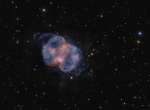 Messier 76
23.07.2010
"Nebula at the right foot of Andromeda ... " begins the description for the 76th object in Charles Messier's 18th century Catalog of Nebulae and Star Clusters. In fact, M76 is one of the fainter objects on the Messier list and is also known by the popular name of the "Little Dumbbell Nebula".
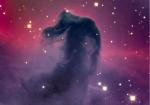 The Dark Horsehead Nebula
29.12.2000
While drifting through the cosmos, sculpted by stellar winds and radiation, this magnificent interstellar dust cloud has chanced to assume a recognizable shape. Fittingly named The Horsehead Nebula it is embedded in the immense complex of star forming gas and dust surrounding the Orion Nebula some 1,500 light-years distant.
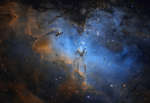 M16 and the Eagle Nebula
15.10.2015
A star cluster around 2 million years young surrounded by natal clouds of dust and glowing gas, M16 is also known as The Eagle Nebula. This beautifully detailed image of the region includes cosmic sculptures made famous in Hubble Space Telescope close-ups of the starforming complex.
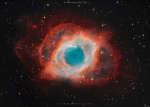 NGC 7293: The Helix Nebula
7.12.2022
A mere seven hundred light years from Earth, toward the constellation Aquarius, a sun-like star is dying. The dying star's last few thousand years have produced the Helix Nebula (NGC 7293), a well studied and nearby example of a Planetary Nebula, typical of this final phase of stellar evolution.
 APOD: 2025 August 4 Б Blue Arcs Toward Andromeda
4.08.2025
What are these gigantic blue arcs near the Andromeda Galaxy (M31)? Discovered in 2022 by amateur astronomers, the faint arcs -- dubbed SDSO 1 -- span nearly the same angular size as M31 itself. At first, their origin was a mystery: are they actually near the Andromeda Galaxy, or alternatively near to our Sun?
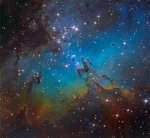 M16 Close Up
9.09.2021
A star cluster around 2 million years young surrounded by natal clouds of dust and glowing gas, M16 is also known as The Eagle Nebula. This beautifully detailed image of the region adopts the colorful Hubble palette and includes cosmic sculptures made famous in Hubble Space Telescope close-ups of the starforming complex.
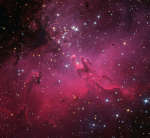 M16 and the Eagle Nebula
15.11.2019
A star cluster around 2 million years young surrounded by natal clouds of dust and glowing gas, M16 is also known as The Eagle Nebula. This beautifully detailed portrait of the region was made with groundbased narrow and broadband image data.
|
January February March April May June July August September October |
|||||||||||||||||||||||||||||||||||||||||||||||||