
|
You entered: Solar System
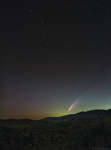 Finding NEOWISE
18.07.2020
If you can see the stars of the Big Dipper, you can find comet NEOWISE in your evening sky tonight. After sunset look for the naked-eye comet below the bowl of the famous celestial kitchen utensil of the north and above your northwestern horizon.
 An Evening Sky Full of Planets
11.01.2025
Only Mercury is missing from a Solar System parade of planets in this early evening skyscape. Rising nearly opposite the Sun, bright Mars is at the far left. The other naked-eye planets Jupiter, Saturn...
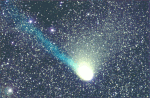 Comet Hale-Bopp Develops a Tail
12.02.1997
Comet Hale-Bopp has quite a tail to tell already. This remarkable comet was first discovered in 1995, even before Comet Hyakutake. Since then, this erupting snowball continues to fall into our inner Solar System and is starting to put on quite a show.
 X ray Transit of Mercury
6.11.1999
This sequence of false color X-ray images captures a rare event - the passage or transit of planet Mercury in front of the Sun. Mercury's small disk is silhouetted against the bright background of X-rays from the hot Solar Corona.
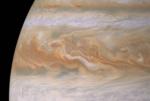 Jupiter Portrait
14.11.2003
Every day is a cloudy day on Jupiter, the Solar System's reigning gas giant. And swirling cloud tops are all you see in this stunningly detailed true color image, a portion of a large digital mosaic portrait of Jupiter recorded from the Cassini spacecraft during its Jovian flyby in December 2000.
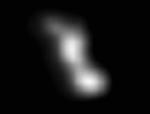 Asteroid 9969 Braille
5.08.1999
NASA probe Deep Space 1 zoomed past asteroid 9969 Braille last week as it continued to test its new ion drive in the inner Solar System. The flyby was the closest approach a spacecraft has ever made to an asteroid. Looking back afterwards, DS1 took the above picture.
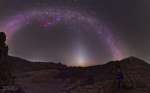 Zodiacal Light Vs. Milky Way
20.03.2010
Ghostly Zodiacal light, featured near the center of this remarkable panorama, is produced as sunlight is scattered by dust in the Solar System's ecliptic plane. In the weeks surrounding the March equinox (today...
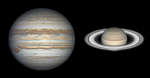 The Giants of Summer
29.07.2020
As Comet NEOWISE sweeps through northern summer skies, Jupiter and Saturn are shining brightly, near opposition. With Jupiter opposite the Sun on July 14 and Saturn on July 21, the giant planets are still near their closest to planet Earth in 2020.
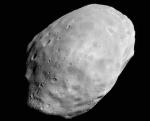 Martian Moon Phobos from MGS
1.07.2003
Why is Phobos so dark? Phobos, the largest and innermost of two Martian moons, is the darkest moon in the entire Solar System. Its unusual orbit and color indicate that it may be a captured asteroid composed of a mixture of ice and dark rock.
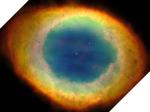 M57: The Ring Nebula
25.06.2006
It looked like a ring on the sky. Hundreds of years ago astronomers noticed a nebula with a most unusual shape. Now known as M57 or NGC 6720, the gas cloud became popularly known as the Ring Nebula.
|
January February March April May June July August September October November |
||||||||||||||||||||||||||||||||||||||||||||||||||||||||