
|
You entered: Earth orbit
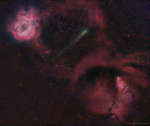 Comet 12P Between Rosette and Cone Nebulas
8.10.2018
Small bits of this greenish-gray comet are expected to streak across Earth's atmosphere tonight. Specifically, debris from the eroding nucleus of Comet 21P / Giacobini-Zinner, pictured, causes the annual Draconids meteor shower, which peaks this evening.
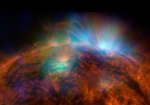 The Sun in X rays from NuSTAR
28.12.2014
Why are the regions above sunspots so hot? Sunspots themselves are a bit cooler than the surrounding solar surface because the magnetic fields that create them reduce convective heating. It is therefore unusual that regions overhead -- even much higher up in the Sun's corona -- can be hundreds of times hotter.
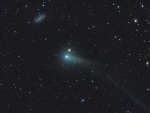 Comet PanSTARRS with Galaxy
6.06.2014
Sweeping slowly through northern skies, the comet PanSTARRS C/2012 K1 posed for this telescopic portrait on June 2nd in the constellation Ursa Major. Now in the inner solar system, the icy body from the Oort cloud sports two tails, a lighter broad dust tail and crooked ion tail extending below and right.
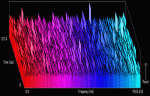 How to Search for Aliens
17.05.1999
"Mom, can I use our computer to search for aliens?" Last week, the SETI@home project released free software that enables many home computers to search for signals from intelligent extra-terrestrials. These signals may have already been detected by the huge Arecibo radio telescope
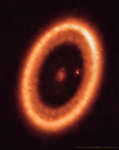 PDS 70: Disk, Planets, and Moons
24.08.2021
It's not the big disk that's attracting the most attention. Although the big planet-forming disk around the star PDS 70 is clearly imaged and itself quite interesting. It's also not the planet on the right, just inside the big disk, thatБs being talked about the most.
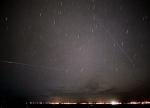 Mir Flares Farewell
23.03.2001
Streaking low across the western horizon after sunset, the Russian Mir space station makes a final pass through the evening sky above the coastal city of Salvador, Brazil. In this 5 minute 20 second time exposure made with ASA 800 film and a wide-angle lens on March 19, setting stars leave short, almost vertical trails.
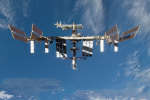 The International Space Station Over Earth
5.10.2009
After undocking, the space shuttle Discovery crew got a memorable view of the developing International Space Station (ISS). Pictured orbiting high above Earth last month, numerous solar panels, trusses, and science modules of the ISS were visible. The Discovery crew brought mission specialist Nicole Stott to the ISS, and returned astronaut Timothy Kopra to Earth.
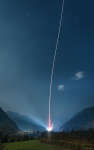 Rocket Launch between Mountains
4.12.2018
What's happening between those mountains? A rocket is being launched to space. Specifically, a Long March 3B Carrier Rocket was launched from Xichang Satellite Launch Center in Sichuan Province in China about two week ago.
 A Space Station Crosses a Busy Sun
11.04.2022
Typically, the International Space Station is visible only at night. Slowly drifting across the night sky as it orbits the Earth, the International Space Station (ISS) can be seen as a bright spot several times a year from many locations.
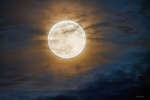 Strawberry Supermoon from China
16.06.2022
There are four Full Supermoons in 2022. Using the definition of a supermoon as a Full Moon near perigee, that is within at least 90% of its closest approach to Earth in a given orbit, the year's Full Supermoon dates are May 16, June 14, July 13, and August 12.
|
January February March April May June July August |
||||||||||||||||||||||||||||||||||||||||||||||||||||||||