
|
You entered: image
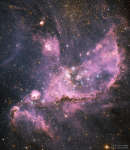 NGC 346: Star Forming Cluster in the SMC
1.12.2020
Are stars still forming in the Milky Way's satellite galaxies? Found among the Small Magellanic Cloud's (SMC's) clusters and nebulas, NGC 346 is a star forming region about 200 light-years across, pictured here in the center of a Hubble Space Telescope image.
 APOD: 2024 January 15 Б Star Cluster IC 348 from Webb
15.01.2024
Sometimes, it's the stars that are the hardest to see that are the most interesting. IC 348 is a young star cluster that illuminates surrounding filamentary dust. The stringy and winding dust appears pink in this recently released infrared image from the Webb Space Telescope.
 Full Moon, Full Mars
18.01.2025
On January 13 a Full Moon and a Full Mars were close, both bright and opposite the Sun in planet Earth's sky. In fact Mars was occulted, passing behind the Moon, when viewed from some locations in North America and northwest Africa.
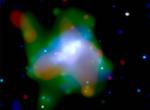 NGC 1569: Heavy Elements from a Small Galaxy
25.07.2002
For astronomers, elements other than hydrogen and helium are sometimes considered to be simply "heavy elements". It's understandable really, because even lumped all together heavy elements make up an exceedingly small fraction of the Universe. Still, heavy elements can profoundly influence galaxy and star formation ... not to mention the formation of planets and people.
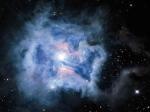 The Iris Nebula from CFHT
29.12.2005
Like delicate cosmic petals, these clouds of interstellar dust and gas have blossomed 1,300 light-years away in the fertile star fields of the constellation Cepheus. Sometimes called the Iris Nebula and dutifully cataloged as NGC 7023, this is not the only nebula in the sky to evoke the imagery of flowers.
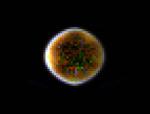 Gamma Ray Earth
3.06.2006
The pixelated planet above is actually our own planet Earth seen in gamma rays - the most energetic form of light. In fact, the gamma rays used to construct this view pack over 35 million electron volts (MeV) compared to a mere two electron volts (eV) for a typical visible light photon.
 An Orion Deep Field
15.10.2006
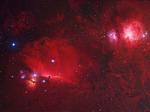
Adrift 1,500 light-years away in one of the night sky's most recognizable constellations, the glowing Orion Nebula and the dark Horsehead Nebula are contrasting cosmic vistas. They both appear in this stunning composite digital image assembled from over 20 hours of data that includes exposures filtered to record emission from hydrogen atoms.
 Hidden Galaxy IC 342 from Kitt Peak
9.01.2008
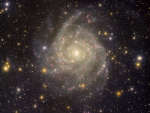
Beautiful nearby spiral galaxy IC 342 could be more famous if it wasn't so hidden. A sprawling island universe, IC 342 would be a prominent galaxy in our night sky, but it is almost hidden from view behind the veil of stars, gas and dust clouds in the plane of our Milky Way galaxy.
 NGC 6888: The Crescent Nebula
15.09.2009
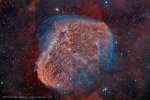
NGC 6888, also known as the Crescent Nebula, is a cosmic bubble about 25 light-years across, blown by winds from its central, bright, massive star. This beautiful portrait of the nebula is from the Isaac Newton Telescope at Roque de los Muchachos Observatory in the Canary Islands.
 Supernova Sonata
26.05.2011
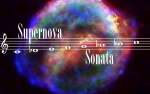
To create a sonata from supernovae, first you have to find the supernovae. To do that composers Alex Parker and Melissa Graham relied on the Canada France Hawaii Telescope (CFHT) Legacy Survey data of four deep fields on the sky monitored from April 2003 through August 2006, adopting 241 Type Ia supernovae.
|
January February March April May June July August September |
|||||||||||||||||||||||||||||||||||||||||||||||||