
|
You entered: night sky
 When Vega is North
7.05.2015
In only about 12,000 years Vega will be the North Star, the closest bright star to our fair planet's North Celestial Pole. By then, when you fix your camera to a tripod...
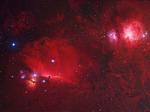 An Orion Deep Field
15.10.2006
Adrift 1,500 light-years away in one of the night sky's most recognizable constellations, the glowing Orion Nebula and the dark Horsehead Nebula are contrasting cosmic vistas. They both appear in this stunning composite digital image assembled from over 20 hours of data that includes exposures filtered to record emission from hydrogen atoms.
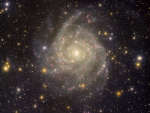 Hidden Galaxy IC 342 from Kitt Peak
8.01.2008
Beautiful nearby spiral galaxy IC 342 could be more famous if it wasn't so hidden. A sprawling island universe, IC 342 would be a prominent galaxy in our night sky, but it is almost hidden from view behind the veil of stars, gas and dust clouds in the plane of our Milky Way galaxy.
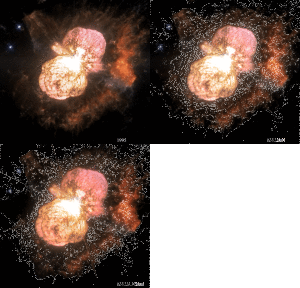 Eta Carinae and the Expanding Homunculus Nebula
1.12.2014
How did the Eta Carinae star system create this unusual expanding nebula? No one knows for sure. About 170 years ago, the southern star system Eta Carinae (Eta Car) mysteriously became the second brightest star system in the night sky. Twenty years later, after ejecting more mass than our Sun, Eta Car unexpectedly faded.
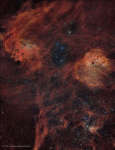 Nebulae in Aurigae
30.11.2015
Rich in star clusters and nebulae, the ancient constellation of the Charioteer (Auriga) rides high in northern winter night skies. Composed from narrow and broadband filter data and spanning nearly 8 Full Moons (4 degrees) on the sky, this deep telescopic view shows off some of Auriga's celestial bounty.
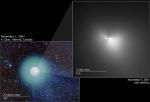 Comet Holmes from the Hubble Space Telescope
27.11.2007
Why did Comet Holmes brighten? The unexpectedly bright Comet 17P/Holmes continues to grace northern skies as a naked-eye addition to the constellation Perseus. Any northern sky enthusiast with a dark sky, a bright curiosity, and a recent sky map should still be able to locate the comet in a few minutes.
 Carina Nebula Panorama from Hubble
22.06.2019
How do violent stars affect their surroundings? To help find out, astronomers created a 48-frame high-resolution, controlled-color panorama of the center of the Carina Nebula, one of the largest star forming regions on the night sky. The featured image, taken in 2007, was the most detailed image of the Carina Nebula yet taken.
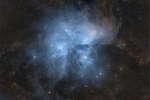 Messier 45: The Daughters of Atlas and Pleione
4.01.2023
Hurtling through a cosmic dust cloud a mere 400 light-years away, the lovely Pleiades or Seven Sisters open star cluster is well-known for its striking blue reflection nebulae. It lies in the night sky toward the constellation Taurus and the Orion Arm of our Milky Way galaxy.
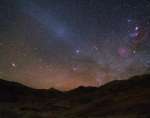 The Gegenschein Over Chile
14.01.2014
Is the night sky darkest in the direction opposite the Sun? No. In fact, a rarely discernable faint glow known as the gegenschein (German for "counter glow") can be seen 180 degrees around from the Sun in an extremely dark sky. The gegenschein is sunlight back-scattered off small interplanetary dust particles.
 Comet Olbers over Kunetice Castle
31.07.2024
A visitor to the inner solar system every 70 years or so Comet 13P/Olbers reached its most recent perihelion, or closest approach to the Sun, on June 30 2024. Now on a return voyage...
|
January February March April May |
|||||||||||||||||||||||||||||||||||||||||||||||||