
|
You entered: dust cloud
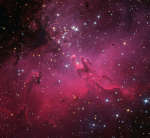 M16 and the Eagle Nebula
15.11.2019
A star cluster around 2 million years young surrounded by natal clouds of dust and glowing gas, M16 is also known as The Eagle Nebula. This beautifully detailed portrait of the region was made with groundbased narrow and broadband image data.
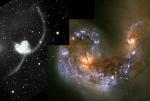 The Antennae Galaxies
22.10.1997
A ground-based telescopic view (left) of the collision between the galaxies NGC4038 and NGC4039 reveals long arcing insect-like "antennae" of luminous matter flung from the scene of the accident. Investigators using the Hubble Space...
 The Mountains of NGC 2174
16.01.2021
This fantastic skyscape lies near the edge of NGC 2174 a star forming region about 6,400 light-years away in the nebula-rich constellation of Orion. It follows mountainous clouds of gas and dust carved...
 Journey to the Center of the Galaxy
22.04.2000
In Jules Verne's science fiction classic A Journey to the Center of the Earth, Professor Hardwigg and his fellow explorers encounter many strange and exciting wonders. What wonders lie at the center of our Galaxy?
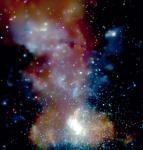 Galactic Center Star Clusters
10.08.2006
If you had x-ray vision, the central regions of our Galaxy would not be hidden from view by cosmic dust clouds. Instead, the Milky Way toward Sagittarius might look something like this. Pleasing...
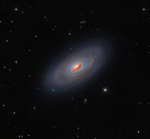 M64: The Black Eye Galaxy
18.06.2015
This big, bright, beautiful spiral galaxy is Messier 64, often called the Black Eye Galaxy or the Sleeping Beauty Galaxy for its heavy-lidded appearance in telescopic views. M64 is about 17 million light-years distant in the otherwise well-groomed northern constellation Coma Berenices.
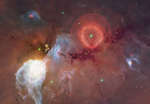 Massive Shell Expelling Star G79 29 0 46
25.09.2017
Stars this volatile are quite rare. Captured in the midst of dust clouds and visible to the right and above center is massive G79.29+0.46, one of less than 100 luminous blue variable stars (LBVs) currently known in our Galaxy.
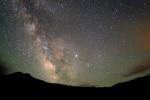 Jupiter, Vesta, and the Milky Way
25.05.2007
In this gorgeous skyscape, gas giant Jupiter along with the stars and cosmic dust clouds of the Milky Way hang over the southern horizon in the early morning hours as seen from Stagecoach, Colorado, USA. Recorded on Thursday, Jupiter is the brightest object near picture center.
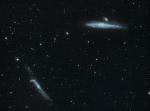 The Whale and the Hockey Stick
12.10.2007
NGC 4631 is a big beautiful spiral galaxy seen edge-on (top right) only 25 million light-years away towards the small northern constellation Canes Venatici. This galaxy's slightly distorted wedge shape suggests to some a cosmic herring and to others the popular moniker of The Whale Galaxy.
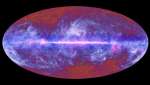 Microwave Milky Way
9.07.2010
Seen from our edge-on perspective, the Milky Way Galaxy sprawls across the middle of this false-color, all sky view. The expansive microwave map is based on 1 year's worth of data from instruments onboard the sky-surveying Planck spacecraft.
|
January February March April May June July August September |
|||||||||||||||||||||||||||||||||||||||||||||||||