
|
You entered: composite image
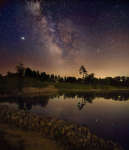 The Milky Way Over Ontario
29.07.2008
Sometimes, after your eyes adapt to the dark, a spectacular sky appears. Such was the case earlier this month over Ontario, Canada, when part of a spectacular sky also became visible in a reflection off a lake.
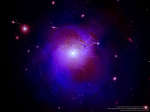 Unexpected X Rays from Perseus Galaxy Cluster
1.01.2018
Why does the Perseus galaxy cluster shine so strangely in one specific color of X-rays? No one is sure, but a much-debated hypothesis holds that these X-rays are a clue to the long-sought identity of dark matter.
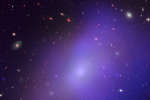 Elliptical Galaxy NGC 1132
12.02.2008
NGC 1132 is one smooth galaxy -- but how did it form? As an elliptical galaxy, NGC 1132 has little dust and gas, and few stars have formed in it recently. Although many elliptical galaxies are in clusters of galaxies, NGC 1132 appears as a large, isolated galaxy toward the constellation of the River (Eridanus).
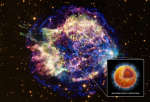 Cooling Neutron Star
4.03.2011
Supernova remnant Cassiopeia A (Cass A) is a comfortable 11,000 light-years away. Light from the Cass A supernova, the death explosion of a massive star, first reached Earth just 330 years ago.
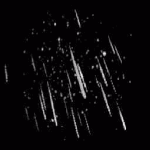 The Perseid Meteor Shower
9.08.1996
From a radiant point in the constellation of Perseus, Comet Swift-Tuttle presents -- The Perseid Meteor Shower -- coming to your night sky this weekend! A bookish E. C. Herrick of New Haven, Connecticut correctly suspected in 1837 that this meteor shower was an annual event.
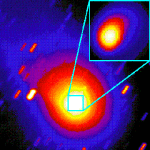 Periodic Comet Swift-Tuttle
18.02.1996
Comet Swift-Tuttle, shown above in false color, is the largest object known to make repeated passes near the Earth. It is also one of the oldest known periodic comets with sightings spanning two millennia.
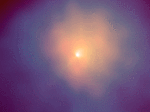 Hyakutake: Comet Atmosphere
10.04.1998
The atmosphere of a comet comes and goes. Approaching the sun, it swells as material from the icy cometary nucleus is warmed and evaporated by increasing sunlight. Immense but tenuous and fleeting, the inner atmosphere or inner "coma" of comet Hyakutake is seen in this false color picture.
 Grand Spiral NGC 5643
25.12.2024
Viewed face-on, grand spiral galaxy NGC 5643 has a festive appearance in this colorful cosmic portrait. Some 55 million light-years distant, the galaxy extends for over 100,000 light-years, seen within the boundaries of the southern constellation Lupus.
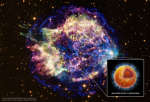 Cooling Neutron Star
30.04.2017
The bright source near the center is a neutron star, the incredibly dense, collapsed remains of a massive stellar core. Surrounding it is supernova remnant Cassiopeia A (Cas A), a comfortable 11,000 light-years away. Light from the Cas A supernova, the death explosion of a massive star, first reached Earth about 350 years ago.
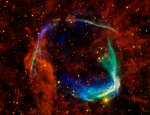 RCW 86: Historical Supernova Remnant
10.11.2011
In 185 AD, Chinese astronomers recorded the appearance of a new star in the Nanmen asterism - a part of the sky identified with Alpha and Beta Centauri on modern star charts. The new star was visible for months and is thought to be the earliest recorded supernova.
|
January February March April May June July August September |
|||||||||||||||||||||||||||||||||||||||||||||||||