
|
You entered: Solar System
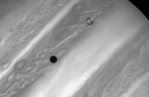 Io's Shadow
7.10.1996
Caught in the act earlier this summer by the Hubble Space Telescope, the volcanic moon Io (above and right of center) and its shadow (black dot) are seen here against Jupiter's clouds.
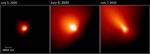 Comet LINEAR Breaks Up
31.07.2000
Unexpectedly, Comet LINEAR is breaking up. In retrospect, clues of its demise have been surfacing all month as the new comet has been approaching the Sun and brightening with dramatic flares. Above, the Hubble Space Telescope captured Comet C/1999 S4 LINEAR early this month blowing off a large piece of its crust.
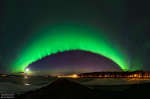 Aurora over Sweden
3.05.2016
It was bright and green and stretched across the sky. This striking aurora display was captured last month just outside of жstersund, Sweden. Six photographic fields were merged to create the featured panorama spanning almost 180 degrees. Particularly striking aspects of this aurora include its sweeping arc-like shape and its stark definition.
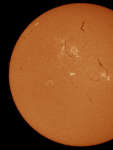 A Transit of Mercury
12.05.2016
On May 9, the diminutive disk of Mercury spent about seven and a half hours crossing in front of the Sun as viewed from the general vicinity of Earth. It was the second of 14 transits of the Solar System's innermost planet in the 21st century.
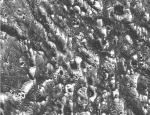 Ancient Cratered Plains on Ganymede
12.07.1996
The largest moon in the Solar System shows regions that are ancient and battered. The high density of craters demonstrate that patches of Ganymede are indeed billions of years old. This photo is one of a series released by NASA two days ago from the Galileo spacecraft orbiting Jupiter.
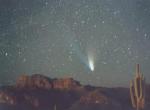 Comet Hale Bopp Over the Superstition Mountains
9.09.1999
Four years ago, Comet Hale-Bopp was discovered out near Jupiter falling toward the inner Solar System. Two years ago, it provided spectacular pictures as it neared its closest approach to the Sun. Still today, spectacular pictures of the brightest comet of the 1990s are surfacing.
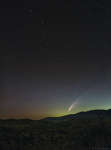 Finding NEOWISE
18.07.2020
If you can see the stars of the Big Dipper, you can find comet NEOWISE in your evening sky tonight. After sunset look for the naked-eye comet below the bowl of the famous celestial kitchen utensil of the north and above your northwestern horizon.
 An Evening Sky Full of Planets
11.01.2025
Only Mercury is missing from a Solar System parade of planets in this early evening skyscape. Rising nearly opposite the Sun, bright Mars is at the far left. The other naked-eye planets Jupiter, Saturn...
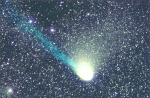 Comet Hale-Bopp Develops a Tail
12.02.1997
Comet Hale-Bopp has quite a tail to tell already. This remarkable comet was first discovered in 1995, even before Comet Hyakutake. Since then, this erupting snowball continues to fall into our inner Solar System and is starting to put on quite a show.
 X ray Transit of Mercury
6.11.1999
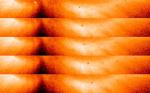
This sequence of false color X-ray images captures a rare event - the passage or transit of planet Mercury in front of the Sun. Mercury's small disk is silhouetted against the bright background of X-rays from the hot Solar Corona.
|
January February March April May June July August September |
|||||||||||||||||||||||||||||||||||||||||||||||||