
|
You entered: spectrum
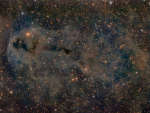 Lynds Dark Nebula 1251
30.09.2016
Stars are forming in Lynds Dark Nebula (LDN) 1251. About 1,000 light-years away, the dusty molecular cloud is part of a complex of dark nebulae mapped toward the Cepheus flare region, drifting above the plane of our Milky Way galaxy.
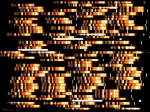 Breaking Distant Light
20.09.2020
In the distant universe, time appears to run slowly. Since time-dilated light appears shifted toward the red end of the spectrum (redshifted), astronomers are able to use cosmological time-slowing to help measure vast distances in the universe.
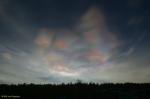 Iridescent clouds
11.03.2003
Why would clouds appear to be different colors? A relatively rare phenomenon known as iridescent clouds can show unusual colors vividly or a whole spectrum of colors simultaneously. These clouds are formed of small water droplets of nearly uniform size.
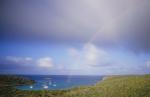 Moonbow with Sailboats
4.07.2001
Have you ever seen a moonbow? Just as rainbows are lit by the Sun, moonbows are lit by the Moon. Since the Sun is so much brighter than the Moon, sunlit rainbows are much brighter and more commonly seen than moonbows. Pictured above is a moonbow stretching over Salt Pond Bay in St.
 Lynds Dark Nebula 1251
24.11.2022
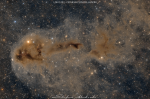
Stars are forming in Lynds Dark Nebula (LDN) 1251. About 1,000 light-years away and drifting above the plane of our Milky Way galaxy, the dusty molecular cloud is part of a complex of dark nebulae mapped toward the Cepheus flare region.
 Breaking Distant Light
4.01.2009
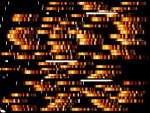
In the distant universe, time appears to run slow. Since time-dilated light appears shifted toward the red end of the spectrum (redshifted), astronomers are able to use cosmological time-slowing to help measure vast distances in the universe.
 Antares and Rho Ophiuchi
9.05.2004
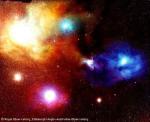
Why is the sky near Antares and Rho Ophiuchi so colorful? The colors result from a mixture of objects and processes. Fine dust illuminated from the front by starlight produces blue reflection nebulae. Gaseous clouds whose atoms are excited by ultraviolet starlight produce reddish emission nebulae. Backlit dust clouds block starlight and so appear dark.
 Lynds Dark Nebula 1251
3.07.2020
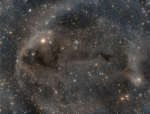
Stars are forming in Lynds Dark Nebula (LDN) 1251. About 1,000 light-years away and drifting above the plane of our Milky Way galaxy, the dusty molecular cloud is part of a complex of dark nebulae mapped toward the Cepheus flare region.
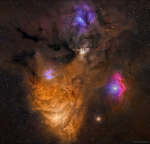 Dark Dust and Colorful Clouds near Antares
27.08.2019
Why is the sky near Antares and Rho Ophiuchi so dusty yet colorful? The colors result from a mixture of objects and processes. Fine dust illuminated from the front by starlight produces blue reflection nebulae. Gaseous clouds whose atoms are excited by ultraviolet starlight produce reddish emission nebulae.
 Moonbow and Rainbows Over Patagonia
10.08.2009
Have you ever seen a moonbow? Just as rainbows are lit by the Sun, moonbows are lit by the Moon. Since the Sun is so much brighter than the Moon, sunlit rainbows are much brighter and more commonly seen than moonbows.
|
January February March April May June July August September |
|||||||||||||||||||||||||||||||||||||||||||||||||