
|
You entered: molecules
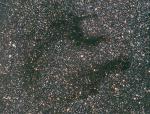 The E Nebula in Aquila
20.08.2003
Several unusual strands of darkness are prominent toward the constellation of Aquila. This particular dark nebula is known as the E Nebula, for its evocative shape, or B142 and B143, for its position(s) on a list of such nebula compiled by Barnard.
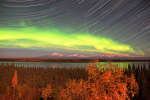 Aurora Over Alaska
6.10.2010
Are those green clouds or aurora? Photographed above two weeks ago, puffy green aurora help the Moon illuminate the serene Willow Lake and the snowy Wrangell and Saint Elias Mountains in eastern Alaska, USA.
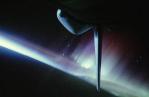 Aurora Astern
10.02.2001
Sailing upside down, 115 nautical miles above Earth, the crew of the Space Shuttle Endeavour made this spectacular time exposure of the southern aurora (aurora australis) in October of 1994. Aurora, also known as the northern and southern lights, appear as luminous bands or streamers of light which can extend to altitudes of 200 miles.
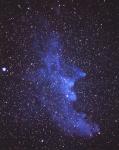 The Witch Head Nebula
9.02.1998
Double, double toil and trouble; Fire burn, and cauldron bubble ... Maybe Macbeth should have consulted the Witch Head Nebula. This suggestively shaped reflection nebula is associated with the bright star Rigel in the constellation Orion. More formally known as IC 2118, the Witch Head Nebula glows primarily by light reflected from Rigel.
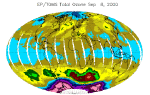 Antarctic Ozone Hole Widens
11.09.2000
It's back, and it's bigger than ever. The ozone hole that has been a cause of concern in recent years has again reformed over Earth's South Pole. The seasonal recurrence of the ozone hole was expected, although the size of the hole has never been so large this early in the season.
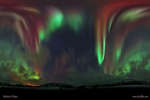 A Full Sky Aurora Over Norway
3.01.2012
Higher than the highest building, higher than the highest mountain, higher than the highest airplane, lies the realm of the aurora. Auroras rarely reach below 60 kilometers, and can range up to 1000 kilometers. Aurora light results from energetic electrons and protons striking molecules in the Earth's atmosphere.
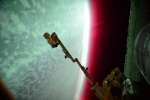 Planet Aurora
26.06.2015
What bizarre alien planet is this ? It's planet Earth of course, seen through the shimmering glow of aurorae from the International Space Station. About 400 kilometers (250 miles) above, the orbiting station is itself within the upper realm of the auroral displays, also watched from the planet's surface on June 23rd.
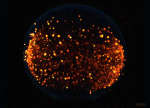 Fire in Space
10.08.2021
What does fire look like in space? In the gravity on Earth, heated air rises and expands, causing flames to be teardrop shaped. In the microgravity of the air-filled International Space Station (ISS), however, flames are spheres.
 Planet Aurora
13.05.2017
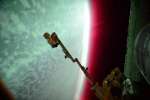
What bizarre alien planet is this? It's planet Earth of course, seen from the International Space Station through the shimmering glow of aurorae. About 400 kilometers (250 miles) above Earth, the orbiting station is itself within the upper realm of the auroral displays.
 Meteor Misses Galaxy
30.04.2019
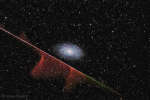
The galaxy was never in danger. For one thing, the Triangulum galaxy (M33), pictured, is much bigger than the tiny grain of rock at the head of the meteor. For another, the galaxy is much farther away -- in this instance 3 million light years as opposed to only about 0.0003 light seconds.
|
January February March April May June July August September |
|||||||||||||||||||||||||||||||||||||||||||||||||