
|
You entered: interstellar medium
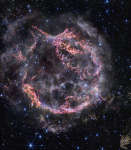 Supernova Remnant Cassiopeia A
5.02.2026
Massive stars in our Milky Way Galaxy live spectacular lives. Collapsing from vast cosmic clouds, their nuclear furnaces ignite and create heavy elements in their cores. After only a few million years for the most massive stars, the enriched material is blasted back into interstellar space where star formation can begin anew.
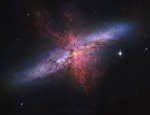 M82: Galaxy with a Supergalactic Wind
22.07.2019
Why is the Cigar Galaxy billowing red smoke? M82, as this starburst galaxy is also known, was stirred up by a recent pass near large spiral galaxy M81. This doesn't fully explain the source of the red-glowing outwardly expanding gas and dust, however.
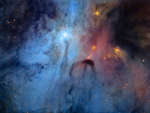 IC 4603: Reflection Nebula in Ophiuchius
23.07.2014
Why does this starfield photograph resemble an impressionistic painting? The effect is created not by digital trickery but by large amounts of interstellar dust. Dust, minute globs rich in carbon and similar in size to cigarette smoke, frequently starts in the outer atmospheres of large, cool, young stars.
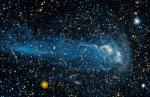 The Tail of a Wonderful Star
17.08.2007
To seventeenth century astronomers, Omicron Ceti or Mira was known as a wonderful star, a star whose brightness could change dramatically in the course of about 11 months. Mira is now seen as the archetype of an entire class of long-period variable stars.
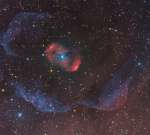 A Halo for NGC 6164
22.05.2014
Beautiful emission nebula NGC 6164 was created by a rare, hot, luminous O-type star, some 40 times as massive as the Sun. Seen at the center of the cosmic cloud, the star is a mere 3 to 4 million years old.
 APOD: 2023 August 2 Б M82: Galaxy with a Supergalactic Wind
1.08.2023
Why is the Cigar Galaxy billowing red smoke? M82, as this starburst galaxy is also known, was stirred up by a recent pass near large spiral galaxy M81. This doesn't fully explain the source of the red-glowing outwardly expanding gas and dust, however.
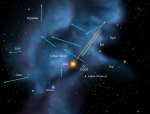 The Local Fluff
24.09.2013
The stars are not alone. In the disk of our Milky Way Galaxy about 10 percent of visible matter is in the form of gas, called the interstellar medium (ISM). The ISM is not uniform, and shows patchiness even near our Sun.
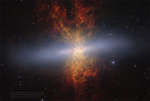 APOD: 2026 June 29 Б M82: Galaxy with a Supergalactic Wind
28.06.2026
Why is the Cigar Galaxy billowing red smoke? M82, as this starburst galaxy is also known, was stirred up by a recent pass near large spiral galaxy M81. This doesn't fully explain the source of the red-glowing outwardly expanding gas and dust, however.
 APOD: 2024 December 22 Б The Local Fluff
21.12.2024
The stars are not alone. In the disk of our Milky Way Galaxy, about 10 percent of visible matter is in the form of gas called the interstellar medium (ISM). The ISM is not uniform and shows patchiness even near our Sun.
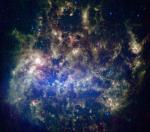 The Large Magellanic Cloud in Infrared
4.09.2006
Where does dust collect in galaxies? To help find out, a team of researchers took the most detailed image ever of gas clouds and dust in the neighboring Large Magellanic Cloud (LMC) galaxy.
|
January February March April May June July August September |
|||||||||||||||||||||||||||||||||||||||||||||||||