
|
You entered: impact crater
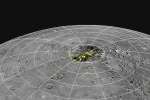 Northern Mercury
1.12.2012
Innermost planet Mercury would probably not be a good location for an interplanetary winter olympics. But new results based on data from the Mercury orbiting MESSENGER spacecraft indicate that it does have substantial water ice in permanently shadowed regions within craters near its north pole.
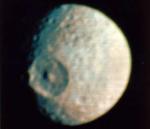 Mimas: Small Moon with a Big Crater
25.04.1999
Mimas is one of the smaller moons of Saturn but shows one of the largest impact craters. In fact, if the impact had been much greater, it would have disrupted the entire satellite. The large crater has been named Herschel after the 1789 discoverer of Mimas, Sir William Herschel.
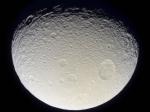 Saturns Moon Tethys from Cassini
29.11.2004
Tethys is one of the larger and closer moons of Saturn. The Cassini spacecraft now orbiting Saturn passed near the frozen moon at the end of October, capturing the most detailed images since the Voyager spacecrafts in the early 1980s.
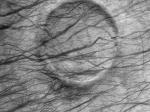 A Dust Devil Crater on Mars
30.12.2003
What caused the streaks in this Martian crater? Since the above image shows streaks occurring both inside and outside the crater, they were surely created after the crater-causing impact. Newly formed trails like these...
 Rolling Across the Rocky Plains of Mars
4.10.2010
You stare out across the rocky plains of Mars. Before you, in every direction, is dark sand and bright rock. Although little has changed here for millions of years, no one has ever seen this view before. You are being sent on a long journey to a distant crater, the largest crater in the region.
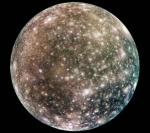 Callisto Full Face
20.01.2002
Callisto's surface shows its age. While probably formed at the same time as Io, the difference between the surfaces of these two moons of Jupiter could hardly be greater. Io's surface is young, shows practically no impact craters, and is continually being repaved by the lava exploding from its many large volcanoes
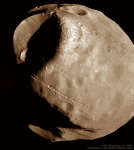 Phobos: Doomed Moon of Mars
25.11.2018
This moon is doomed. Mars, the red planet named for the Roman god of war, has two tiny moons, Phobos and Deimos, whose names are derived from the Greek for Fear and Panic. The origin of the Martian moons is unknown, though, with a leading hypothesis holding that they are captured asteroids.
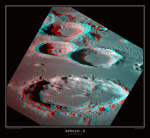 Southwest Mare Fecunditatis
3.03.2018
Frank Borman, James Lovell, and William Anders journeyed from Earth to the Moon and back again in December of 1968. From lunar orbit, their view of craters in southwest Mare Fecunditatis is featured in this stereo anaglyph, best experienced from armchairs on planet Earth with red/blue glasses.
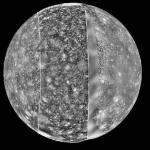 Callisto Full Face
9.12.1996
Callisto's surface shows its age. While probably formed at the same time as Io, the difference between the surfaces of these two moons of Jupiter could hardly be greater. Io's surface is young, shows practically no impact craters, and is continually being repaved by the lava exploding from its many large volcanoes.
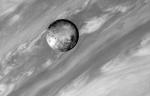 5 Million Miles From Io
11.03.1999
Twenty years ago this month, NASA's Voyager 1 spacecraft flew past Jupiter and its moons. This sharp picture of moon Io against a background of gas giant Jupiter's diffuse swirling cloud bands was recorded by Voyager's camera from a distance of about 5 million miles.
|
January February March April May June July August September |
|||||||||||||||||||||||||||||||||||||||||||||||||