
|
You entered: face
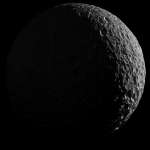 Mimas in Saturnlight
16.03.2017
Peering from the shadows, the Saturn-facing hemisphere of Mimas lies in near darkness alongside a dramatic sunlit crescent. The mosaic was captured near the Cassini spacecraft's final close approach on January 30, 2017. Cassini's camera was pointed in a nearly sunward direction only 45,000 kilometers from Mimas.
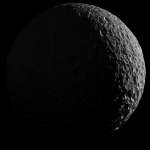 Mimas in Saturnlight
3.08.2019
Peering from the shadows, the Saturn-facing hemisphere of Mimas lies in near darkness alongside a dramatic sunlit crescent. The mosaic was captured near the Cassini spacecraft's final close approach on January 30, 2017. Cassini's camera was pointed in a nearly sunward direction only 45,000 kilometers from Mimas.
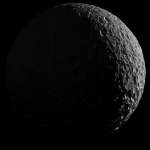 Mimas in Saturnlight
30.07.2021
Peering from the shadows, the Saturn-facing hemisphere of Mimas lies in near darkness alongside a dramatic sunlit crescent. The mosaic was captured near the Cassini spacecraft's final close approach on January 30, 2017. Cassini's camera was pointed in a nearly sunward direction only 45,000 kilometers from Mimas.
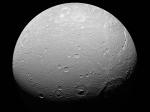 APOD: 2007 August 1- Unusual Cratering on Saturns Dione
1.08.2007
Why does one half of Dione have more craters than the other? Start with the fact that Saturn's moon Dione always has one side that faces Saturn, and always has one side that faces away. This is similar to Earth's Moon.
 Gibbous Moon beyond Swedish Mountain
19.11.2018
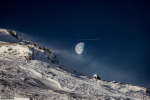
This is a gibbous Moon. More Earthlings are familiar with a full moon, when the entire face of Luna is lit by the Sun, and a crescent moon, when only a sliver of the Moon's face is lit.
 The Bay of Rainbows
8.02.2008
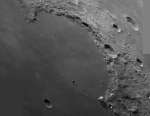
Dark, smooth regions that cover the Moon's familiar face are called by Latin names for oceans and seas. The naming convention is historical, though it may seem a little ironic to denizens...
 NGC 3314: When Galaxies Overlap
7.05.2005
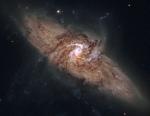
NGC 3314 consists of two large spiral galaxies which just happen to almost exactly line-up. The foreground spiral is viewed nearly face-on, its pinwheel shape defined by young bright star clusters. But against the glow of the background galaxy, dark swirling lanes of interstellar dust are also seen to echo the face-on spiral's structure.
 Ultraviolet Earth
10.06.1996
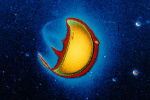
Here's a switch: the above picture is of the Earth taken from a lunar observatory! This false color picture shows how the Earth glows in ultraviolet (UV) light. UV light is so blue humans can't see it.
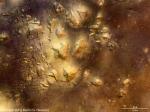 APOD: 2006 September 26- Mars Express: Return to Cydonia
26.09.2006
The unusual stone mesas of the Cydonia region on Mars are quite striking in appearance. Last week, the Mars Express project released a new close-up image of a portion of the Cydonia region on Mars. This new image, taken by the robotic Mars Express spacecraft now orbiting Mars, shows an area about 90 kilometers wide.
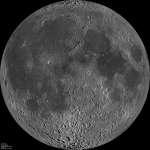 Lunar Nearside
3.03.2011
About 1,300 images from the Lunar Reconnaissance Orbiter spacecraft's wide angle camera were used to compose this spectacular view of a familiar face - the lunar nearside. But why is there a lunar nearside? The Moon rotates on its axis and orbits the Earth at the same rate, about once every 28 days.
|
January February March April May June July August |
||||||||||||||||||||||||||||||||||||||||||||||||||||||||