
|
You entered: composite image
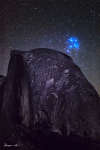 Pleiades over Half Dome
19.07.2022
Stars come in bunches. The most famous bunch of stars on the sky is the Pleiades, a bright cluster that can be easily seen with the unaided eye. The Pleiades lies only about 450 light years away, formed about 100 million years ago, and will likely last about another 250 million years.
 APOD: 2024 December 11 Б The Shells and Jets of Galaxy Centaurus A
11.12.2024
What's the closest active galaxy to planet Earth? That would be Centaurus A, cataloged as NGC 5128, which is only 12 million light-years distant. Forged in a collision of two otherwise normal galaxies...
 APOD: 2025 January 27 Б Pleiades over Half Dome
27.01.2025
Stars come in bunches. The most famous bunch of stars on the sky is the Pleiades, a bright cluster that can be easily seen with the unaided eye. The Pleiades lies only about 450 light years away, formed about 100 million years ago, and will likely last about another 250 million years.
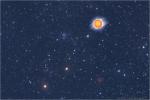 Stars and the Solstice Sun
21.06.2007
If you could turn off the atmosphere's ability to scatter overwhelming sunlight, today's daytime sky might look something like this ... with the Sun surrounded by the stars of the constellations Taurus and Gemini. Of course, today is the Solstice.
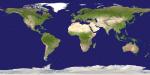 Earth in True Color
5.03.2002
Here are the true colors of planet Earth. Blue oceans dominate our world, while areas of green forest, brown mountains, tan desert, and white ice are also prominent. Oceans appear blue not only because water itself is blue but also because seawater frequently scatters light from a blue sky.
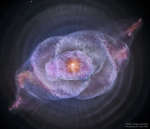 The Cats Eye Nebula in Optical and Xray
1.05.2019
To some it looks like a cat's eye. To others, perhaps like a giant cosmic conch shell. It is actually one of brightest and most highly detailed planetary nebula known, composed of gas expelled in the brief yet glorious phase near the end of life of a Sun-like star.
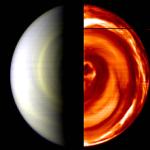 Swirling Clouds Over the South Pole of Venus
1.05.2007
What's happening over the South Pole of Venus? To find out, scientists sent the robot Venus Express spacecraft now orbiting Venus directly over the lower spin axis of Earth's overheated twin. Venus Express confirmed there a spectacular massive swirling storm system with similarities to the vortex recently imaged over Saturn's South Pole.
 APOD: 2024 January 7 Б The Cats Eye Nebula in Optical and X-ray
7.01.2024
To some it looks like a cat's eye. To others, perhaps like a giant cosmic conch shell. It is actually one of the brightest and most highly detailed planetary nebula known, composed of gas expelled in the brief yet glorious phase near the end of life of a Sun-like star.
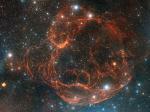 Simeis 147: Supernova Remnant from Palomar
29.11.2005
It's easy to get lost following the intricate filaments in this detailed image of faint supernova remnant Simeis 147. Seen towards the constellation Taurus it covers nearly 3 degrees (6 full moons) on the sky corresponding to a width of 150 light-years at the stellar debris cloud's estimated distance of 3,000 light-years.
 APOD: 2024 March 18 Б Comet Pons Brooks Swirling Coma
18.03.2024
A bright comet will be visible during next month's total solar eclipse. This very unusual coincidence occurs because Comet 12P/Pons-Brooks's return to the inner Solar System places it by chance only 25 degrees away from the Sun during Earth's April 8 total solar eclipse.
|
January February March April May June July August September |
|||||||||||||||||||||||||||||||||||||||||||||||||