
|
You entered: binary star
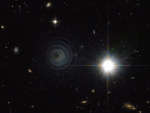 An Extraordinary Spiral from LL Pegasi
14.09.2010
What created the strange spiral structure on the left? No one is sure, although it is likely related to a star in a binary star system entering the planetary nebula phase, when its outer atmosphere is ejected.
 NGC 1360: The Robin's Egg Nebula
5.08.2023
This pretty nebula lies some 1,500 light-years away, its shape and color in this telescopic view reminiscent of a robin's egg. The cosmic cloud spans about 3 light-years, nestled securely within the boundaries of the southern constellation Fornax. Recognized as a planetary nebula, egg-shaped NGC 1360 doesn't represent a beginning though.
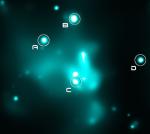 The Swarm
29.07.2006
What do you call a group of black holes ... a flock, a brace, a swarm? Monitoring a region around the center of our Galaxy, astronomers have indeed found evidence for a surprisingly large number...
 APOD: 2025 August 31 Б NGC 7027: The Pillow Planetary Nebula
31.08.2025
What created this unusual planetary nebula? Dubbed the Pillow Nebula and the Flying Carpet Nebula, NGC 7027 is one of the smallest, brightest, and most unusually shaped planetary nebulas known. Given its expansion rate, NGC 7027 first started expanding, as visible from Earth, about 600 years ago.
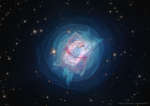 Bright Planetary Nebula NGC 7027 from Hubble
30.06.2020
What created this unusual planetary nebula? NGC 7027 is one of the smallest, brightest, and most unusually shaped planetary nebulas known. Given its expansion rate, NGC 7027 first started expanding, as visible from Earth, about 600 years ago.
 Sirius: The Brightest Star in the Night
2.09.1996
Sirius is the brightest star in the night sky. Intrinsically, Sirius is over 20 times brighter than our Sun and over twice as massive. As Sirius is 8.7 light years distant, it is not the closest star system -- the Alpha Centauri system holds this distinction.
 APOD: 2025 May 14 Б NGC 1360: The Robins Egg Nebula
14.05.2025
This pretty nebula lies some 1,500 light-years away, its shape and color in this telescopic view reminiscent of a robin's egg. The cosmic cloud spans about 3 light-years, nestled securely within the boundaries of the southern constellation of the Furnace (Fornax).
 DEM L71: When Small Stars Explode
14.03.2003
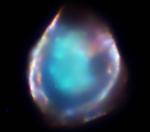
Large, massive stars end their furious lives in spectacular supernova explosions -- but small, low mass stars may encounter a similar fate. In fact, instead of simply cooling off and quietly fading away, some white...
 Sirius: The Brightest Star in the Night
11.06.2000
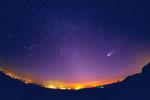
Sirius is the brightest star in the night sky. Sirius is visible on the far left of the above photograph, to the left of the constellation of Orion and Comet Hale-Bopp. Intrinsically, Sirius is over 20 times brighter than our Sun and over twice as massive.
 APOD: 2020 August 14 Б NGC 5189: An Unusually Complex Planetary Nebula
14.08.2020
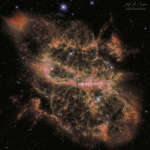
Why is this nebula so complex? When a star like our Sun is dying, it will cast off its outer layers, usually into a simple overall shape. Sometimes this shape is a sphere, sometimes a double lobe, and sometimes a ring or a helix.
|
January February March April May June July August September |
|||||||||||||||||||||||||||||||||||||||||||||||||