
|
You entered: atmosphere
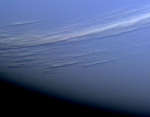 Two Hours Before Neptune
8.08.2010
Two hours before closest approach to Neptune in 1989, the Voyager 2 robot spacecraft snapped this picture. Clearly visible for the first time were long light-colored cirrus-type clouds floating high in Neptune's atmosphere. Shadows of these clouds can even be seen on lower cloud decks.
 Two Hours Before Neptune
5.10.1999
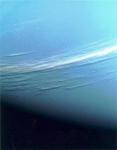
Two hours before closest approach to Neptune in 1989, the Voyager 2 robot spacecraft snapped this picture. Clearly visible for the first time were long light-colored cirrus-type clouds floating high in Neptune's atmosphere. Shadows of these clouds can even be seen on lower cloud decks.
 APOD: 2025 October 2 Б Pluto at Night
2.10.2025
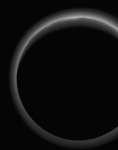
The night side of Pluto spans this shadowy scene. In the stunning spacebased perspective, the Sun is 4.9 billion kilometers (almost 4.5 light-hours) behind the dim and distant world. It was captured by far flung New Horizons in July of 2015 when the spacecraft was at a range of some 21,000 kilometers from Pluto.
 Aurora and Volcanic Light Pillar
23.09.2014
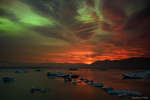
That's no sunset. And that thin red line just above it -- that's not a sun pillar. The red glow on the horizon originates from a volcanic eruption, and the red line is the eruption's reflection from fluttering atmospheric ice crystals. This unusual volcanic light pillar was captured over Iceland earlier this month.
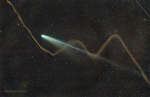 APOD: 2025 October 27 Б Two Tails of Comet Lemmon
27.10.2025
How many bright tails does Comet Lemmon have? Two. In the featured image it appears to have three, but why? The reason is that the zigzagging brown filament is a persistent meteor train that by luck appeared in front of the distant comet C/2025 A6 (Lemmon).
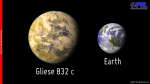 Gliese 832c: The Closest Potentially Habitable Exoplanet
9.07.2014
This planet is only 16 light years away -- could it harbor life? Recently discovered exoplanet Gliese 832c has been found in a close orbit around a star that is less bright than our Sun.
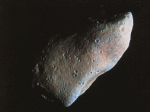 Asteroid Gaspra's Best Face
20.10.1995
Above is the best yet color image of the asteroid Gaspra based on data returned by NASA's Galileo spacecraft. Color variations have been added to high resolution images and enhanced to highlight changes in reflectivity, surface structure and composition. The illuminated portion of the asteroid is about 11 miles long.
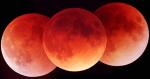 A Lunar Eclipse in Three Exposures
25.01.2000
Our Moon turned red last week. The reason was that during the night of January 20, a total lunar eclipse occurred. The above digitally superimposed photographs captured the Moon three times during this lunar...
 Jupiter, Io, and Shadow
26.12.2000
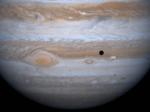
Just as planets orbit our Sun, Jupiter's Moons orbit Jupiter. Pictured above is the closest of Jupiter's Galilean Satellites, Io, superposed in front of the giant planet it circles. To the left of Io is a dark spot that is its own shadow.
 Smog Over New York
7.05.2002
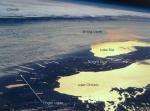
What is not pretty about the above picture? In a word: smog. In 2000 October the orbiting Space Shuttle Discovery photographed update New York just at sunset. Visible is golden sunlight reflecting from two of the Great Lakes (Erie and Ontario), and several of the Finger Lakes.
|
January February March April May June July August September |
|||||||||||||||||||||||||||||||||||||||||||||||||