
|
You entered: all sky
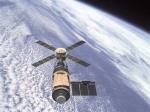 Skylab Over Earth
29.04.2006
Skylab was an orbiting laboratory launched by a in May 1973. Skylab, pictured above, was visited three times by NASA astronauts who sometimes stayed as long as two and a half months. Many scientific tests were performed on Skylab, including astronomical observations in ultraviolet and X-ray light.
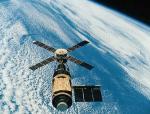 Skylab Over Earth
28.05.2000
Skylab was an orbiting laboratory launched by a Saturn V rocket in May 1973. Skylab was visited three times by NASA astronauts who sometimes stayed as long as two and a half months. Many scientific tests were performed on Skylab, including astronomical observations in ultraviolet and X-ray light.
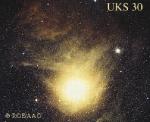 Antares
24.06.1997
Antares is a huge star. In a class called red supergiant, Antares is about 700 times the size of our own Sun, 15 times more massive, and 10,000 times brighter. Antares is the brightest star in the constellation of Scorpius and one of the brighter stars in all the night sky.
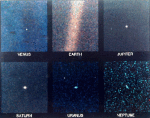 Our Solar System from Voyager
19.08.1995
After taking its spectacular pictures of the outer solar system planets, Voyager 1 looked back at six planets from the inner solar system. Here Venus, Earth, Jupiter, Saturn, Uranus, and Neptune, were all visible across the sky.
 Antares
26.07.1998
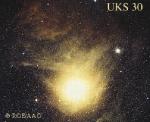
Antares is a huge star. In a class called red supergiant, Antares is about 700 times the diameter of our own Sun, 15 times more massive, and 10,000 times brighter. Antares is the brightest star in the constellation of Scorpius and one of the brighter stars in all the night sky.
 A Southern Sky View
10.03.2002
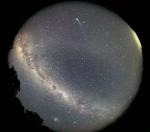
On 1996 March 22, a Galaxy and a comet shared the southern sky. They were captured together, from horizon to horizon, in the night sky above Loomberah, New South Wales, Australia by astronomer Gordon Garradd. Garradd used a home made all-sky camera with a fisheye lens, resulting in a circular 200 degree field of view.
 COBE Dipole: Speeding Through the Universe
8.03.1997
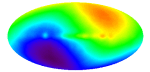
Our Earth is not at rest. The Earth moves around the Sun. The Sun orbits the center of the Milky Way Galaxy. The Milky Way Galaxy orbits in the Local Group. The Local Group falls toward the Virgo Cluster of Galaxies.
 Our Solar System from Voyager
17.05.1998
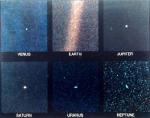
After taking spectacular pictures of our Solar System's outer planets, Voyager 1 looked back at six planets to take our Solar System's first family portrait. Here Venus, Earth, Jupiter, Saturn, Uranus, and Neptune, were all visible across the sky.
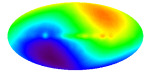 COBE Dipole: Speeding Through the Universe
5.02.1996
Our Earth is not at rest. The Earth moves around the Sun. The Sun orbits the center of the Milky Way Galaxy. The Milky Way Galaxy orbits in the Local Group. The Local Group falls toward the Virgo Cluster of Galaxies.
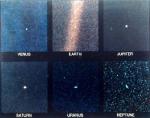 Our Solar System from Voyager
14.12.1996
After taking spectacular pictures of our Solar System's outer planets, Voyager 1 looked back at six planets to take our Solar System's first family portrait. Here Venus, Earth, Jupiter, Saturn, Uranus, and Neptune, were all visible across the sky.
|
January February March April May June July August September |
|||||||||||||||||||||||||||||||||||||||||||||||||