
|
You entered: Moon
 Ida and Dactyl: Asteroid and Moon
7.08.1999
This asteroid has a moon! The robot spacecraft Galileo currently exploring the Jovian system, encountered and photographed two asteroids during its long journey to Jupiter. The second asteroid it photographed, Ida, was discovered to have a moon which appears as a small dot to the right of Ida in this picture.
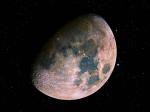 Colorful Moon Mosaic
7.09.2006
No single exposure can easily capture faint stars along with the subtle colors of the Moon. But this dramatic composite view highlights both. The mosaic digitally stitches together fifteen carefully exposed high resolution images of a bright, gibbous Moon and a representative background star field.
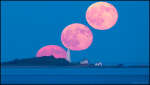 Full Moon and Boston Light
13.07.2017
This well-planned telephoto timelapse captures July's Full Moon rise across outer Boston Harbor, Massachusetts, planet Earth. In the foreground, the historic terrestrial beacon is known as Boston Light. July's Full Moon...
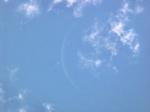 Crescent Venus and Moon
30.10.2006
There's something behind these clouds. Those faint graceful arcs, upon inspection, are actually far, far in the distance. They are the Earth's Moon and the planet Venus. Both the Moon and Venus are bright enough to be seen during the day, and both are quite capable of showing a crescent phase.
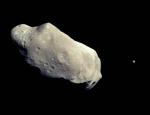 Ida and Dactyl: Asteroid and Moon
19.06.2004
This asteroid has a moon! The robot spacecraft Galileo destined to explore the Jovian system, encountered and photographed two asteroids during its long interplanetary voyage to Jupiter. The second asteroid it photographed, Ida, was discovered to have a moon which appears as a small dot to the right of Ida in this image from 1993.
 Moon Games
29.11.2025
This is not a screen from a video game. Nestled below the tree-line, the small mountain church does look like it might be hiding from Moon though. In the well-composed telephoto snapshot, taken on November 23, the church walls are partly reflecting light from terrestrial flood lights.
 Shadowed Moon and Mountain
18.07.2019
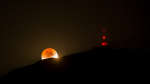
On July 16 the Moon celebrated the 50th anniversary of the launch of Apollo 11 with a lunar eclipse visible from much of planet Earth. In this view part of the lunar disk is immersed in Earth's dark, reddened umbral shadow. Near the maximum eclipse phase, it just touches down along a mountain ridge.
 Blasting Off From the Moon
9.06.1996
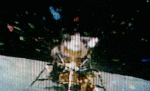
How did the astronauts get back from the Moon? The Lunar Module that landed two astronauts on the Moon actually came apart. The top part containing the astronauts carried additional rocket fuel which allowed it to blast away, leaving the bottom part on the Moon forever.
 Standing on the Moon
2.02.1997
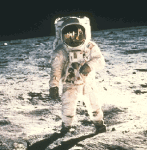
Humans once walked on the Moon. Pictured above is the second person to stand on the lunar surface: Edwin "Buzz" Aldrin. During this Apollo 11 mission, Neil Armstrong (the first person to walk on the moon) and Buzz Aldrin landed on the Moon while Michael Collins circled in the Command Module above.
 X-Raying the Moon
31.08.1995
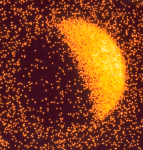
Above is a picture of the Moon taken in X-rays by the Roentgen Observatory Satellite ROSAT in 1990. This famous picture shows three distinct regions: a bright X-ray sky, a bright part of the Moon, and a relatively dark part of the Moon.
|
January February March April May June July August September October |
|||||||||||||||||||||||||||||||||||||||||||||||||