
|
You entered: Martian surface
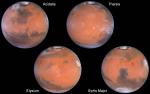 Four Faces of Mars
5.07.1999
As Mars rotates, most of its surface becomes visible. During Earth's recent pass between Mars and the Sun, the Hubble Space Telescope was able to capture the most detailed time-lapse pictures ever from the Earth. Dark and light sand and gravel create an unusual blotted appearance for the red planet.
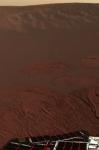 A Landing at Meridiani Planum
25.01.2004
After an interplanetary journey of nearly 300 million miles, Opportunity bounced down on the martian surface at about 9:05 pm PST Saturday, its final plunge cushioned by airbags. Now the second NASA rover...
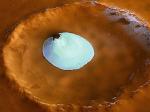 Water Ice in a Maritan Crater
20.07.2005
What lies on the floor of this Martian crater? A frozen patch of water ice. The robotic Mars Express spacecraft took the above image in early February. The ice pocket was found in a 35-kilometer wide crater that resides 70 degrees north of the Martian equator.
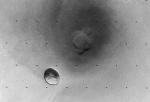 Phobos Over Mars
28.11.2003
Hurtling through space a mere 3,000 miles above the Martian surface, the diminutive moon Phobos (below and left of center) was imaged against the backdrop of a large shield volcano by the Viking 2 Orbiter in 1977.
 A Year of Mars Roving
30.12.2004
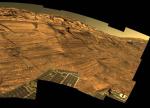
Landing on Mars in January, NASA's twin rovers Spirit and Opportunity have now each spent over 330 sols roving the martian surface. Still healthy and well in to extended missions, the golfcart sized robots have operated five times longer than planned.
 3D Ingenuity
7.04.2021
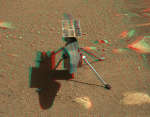
The multicolor, stereo imaging Mastcam-Z on the Perseverance rover zoomed in to captured this 3D close-up (get out your red/blue glasses) of the Mars Ingenuity helicopter on mission sol 45, April 5. That...
 Opportunity s Horizon
3.02.2004
Remarkably, the Opportunity Mars rover lies in a small martian impact crater about 3 meters deep and 22 meters wide. For 360 degrees, Opportunity's horizon stretches to the right in this new color mosaic image from the rover's panoramic camera.
 Martian Moon Phobos from MGS
1.07.2003
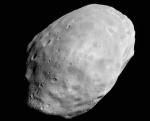
Why is Phobos so dark? Phobos, the largest and innermost of two Martian moons, is the darkest moon in the entire Solar System. Its unusual orbit and color indicate that it may be a captured asteroid composed of a mixture of ice and dark rock.
 October Mars
28.10.2005
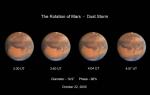
This October, Mars has become a bright, yellowish star in planet Earth's sky as it approaches oppositon, the period when Mars and Earth pass close as they orbit the Sun. How close is Mars? A mere 70 million kilometers or so, close enough to allow Earth-bound astronomers excellent views of the alluring Red Planet.
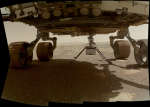 Ingenuity on Sol 39
2.04.2021
The Mars Ingenuity Helicopter, all four landing legs down, was captured here on sol 39 (March 30) slung beneath the belly of the Perseverance rover. The near ground level view is a mosaic of images from the WATSON camera on the rover's SHERLOC robotic arm.
|
January February March April May June July August |
||||||||||||||||||||||||||||||||||||||||||||||||||||||||